




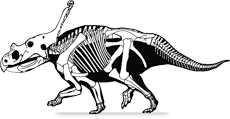
Pronunciation: VAH-guh-SEH-ruh-tops
Meaning: Wandering Horn Face
Author/s: Sampson et al. (2010)
Synonyms: Chasmosaurus irvinensis
First Discovery: Alberta, Canada
Acta Ordinal: #730
Vagaceratops irvinensis
Vagaceratops differs from almost all of its horn-faced relatives by not having any horns on its face. Well, not very impressive ones, anyway. It has a small stump on its snout and two nubbins of bone on its brow where horns would normally be. But its short and wide skull frill with two windows (parietal fenestrae) does sport ten forwards and downwards curving "hornlets" (epoccipitals) in the style of, but more modest than those seen in, Kosmoceratops to whom it is closely related. Unlike Kosmoceratops, however, its current name wasn't its original name.
Vagaceratops was initially identified as the common as muck Chasmosaurus belli in 1958, so lay ignored for many years. Heck, preparation didn't begin until 1980, and it was done in instalments until completely free of fossil-obscuring matrix in 2003, by which point it had already been sporting a shiny new name—Chasmosaurus irvinensis—for two years, courtesy of Robert Holmes. Holmes returned in 2007 to restudy what turned out to be one of the most complete and articulated ceratopsians known, and one which had, unusually, perished in an upright position with both right limbs tucked neatly beneath its torso. This was good news, as it could answer an age-old question of whether ceratopsian dinosaurs held their front legs upright like an elephant's or bent outwards at the knees like a crocodile's. Or, at least, that was the hope. The conclusion, however, was that ceratopsian forelimbs were neither one nor the other but somewhere in between and have no comparison amongst extant critters.
As well as a lack of horns, Chasmosaurus irvinensis had a wider snout, a more modest frill, and a broader chest than any known specimen of Chasmosaurus, so Sampson et al. renamed it Vagaceratops in 2010. Unusual pathologies of its vertebrae and hands suggest Vagaceratops was very old and had perhaps been taken quietly by Father Time as it slept or was unable to move. It seems even ceratopsian pensioners could succumb to arthritis.
Vagaceratops was initially identified as the common as muck Chasmosaurus belli in 1958, so lay ignored for many years. Heck, preparation didn't begin until 1980, and it was done in instalments until completely free of fossil-obscuring matrix in 2003, by which point it had already been sporting a shiny new name—Chasmosaurus irvinensis—for two years, courtesy of Robert Holmes. Holmes returned in 2007 to restudy what turned out to be one of the most complete and articulated ceratopsians known, and one which had, unusually, perished in an upright position with both right limbs tucked neatly beneath its torso. This was good news, as it could answer an age-old question of whether ceratopsian dinosaurs held their front legs upright like an elephant's or bent outwards at the knees like a crocodile's. Or, at least, that was the hope. The conclusion, however, was that ceratopsian forelimbs were neither one nor the other but somewhere in between and have no comparison amongst extant critters.
As well as a lack of horns, Chasmosaurus irvinensis had a wider snout, a more modest frill, and a broader chest than any known specimen of Chasmosaurus, so Sampson et al. renamed it Vagaceratops in 2010. Unusual pathologies of its vertebrae and hands suggest Vagaceratops was very old and had perhaps been taken quietly by Father Time as it slept or was unable to move. It seems even ceratopsian pensioners could succumb to arthritis.
(The wandering Horn Face from Irvine)Etymology
Vagaceratops is derived from the Latin "vagus" (wanderer) and the Greek "keras" (horn) and "-ops" (face), in reference to its presence in Alberta (northern Laramidia) during the Late Campanian while its closest relative, Kosmoceratops, was living in Utah (southern Laramidia) during the same period.
The species epithet, irvinensis, is derived from "Irvine" (for the town of Irvine: population of 350), close to where the skeleton was found, and the Latin "ensis" (from). ZooBank registry: urn:lsid:zoobank.org:act:0A2138B8-E59C-4D24-A221-B59529C4A402.
Discovery
The remains of Vagaceratops were discovered in the Dinosaur Park Formation (Belly River Group), Southwest of Irvine, Alberta, Canada, by Mr. Luke Lindoe and collected by a team led by Wann Langston in 1958. Preparation was initiated in the late 1980s by Drs. Wann Langston and Dale Russell to address the ongoing debate surrounding forelimb posture in ceratopsians.
The holotype (NMC 41357) is a partial skull. Referred material includes TMP 87.45.1 (a partial skull found 4.8 km NW of Iddesleigh) and TMP 98.102.8 (a partial skull found near the village of Onefour). Another skull (TMP 2011.053.0046, from Manyberries) was assigned to Vagaceratops in 2018.


