




Pronunciation: SOR-o-PEL-tuh
Meaning: Lizard shield
Author/s: Ostrom (1970)
Synonyms: None known
First Discovery: Montana, USA
Acta Ordinal: #229
Sauropelta edwardsorum
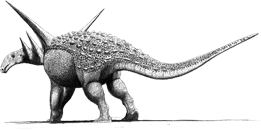
Sauropelta edwardsorum is one of the most recognizable nodosaurs — a family of herbivorous dinosaurs closely related to ankylosaurids — for two reasons; a tail made up of at least 40 vertebrae that accounts for around half of its total body length and two rows of parallel spines on each side of its neck that increased in size towards the shoulders, where they were replaced with a pair of satanic yard-long spikes.
It was low-slung with a broad ribcage and pelvis, shorter front legs than hind legs, a rather flat skull - thick with armour plates, and osteoderms (bony masses embedded in the skin) which were thickest around the neck and base of the tail and would have restricted its movement somewhat. Like all nodosaurids, it lacked the mace-like tail of its sisters — the ankylosaurids — and had a long thin snout ending in a downwards curve, with plant cutting teeth in both the upper and lower jaws.
In 1888 O.C. Marsh named Priconodon (saw-cone tooth) based on a single, worn tooth discovered in the Arundel Formation (then called the Potomac Formation) of Muirkirk, Maryland which he compared to stegosaur teeth. Walter Coombs assigned this tooth to nodosauridae in 1978, and it may actually belong to Sauropelta.
It was low-slung with a broad ribcage and pelvis, shorter front legs than hind legs, a rather flat skull - thick with armour plates, and osteoderms (bony masses embedded in the skin) which were thickest around the neck and base of the tail and would have restricted its movement somewhat. Like all nodosaurids, it lacked the mace-like tail of its sisters — the ankylosaurids — and had a long thin snout ending in a downwards curve, with plant cutting teeth in both the upper and lower jaws.
In 1888 O.C. Marsh named Priconodon (saw-cone tooth) based on a single, worn tooth discovered in the Arundel Formation (then called the Potomac Formation) of Muirkirk, Maryland which he compared to stegosaur teeth. Walter Coombs assigned this tooth to nodosauridae in 1978, and it may actually belong to Sauropelta.
Etymology
Although discovered by Barnum Brown who unofficially tagged his find "Peltosaurus" (a name that Edward Drinker Cope had already assigned to an extinct genus of Anguid lizard in 1873) Sauropelta wasn't officially named until John Ostrom made further discoveries in 1970. The name is derived from the Greek "sauros" (lizard) and "pelte" (shield) because of its heavy armour. The species epithet, edwardsorum — originally "edwardsi" but emended by Olshevsky in 1991 to conform to Latin plural rules — honors Nell and Tom Edwards of Bridger, Montana, in appreciation of the hospitality and assistance afforded to Yale field crews.
Discovery
The first Sauropelta fossils (a partial skeleton catalogued as AMNH 3032) were discovered at a Crow Indian reservation in the Cloverly Formation, Big Horn County, Montana, USA, by Barnum Brown in the early 1930s. The Cloverly dates to between 118 and 110 mya which makes Sauropelta the oldest known nodosaurid.


