





Pronunciation: HOR-ta-lo-TAR-sus
Meaning: Young-bird ankle
Author/s: Seeley (1894)
Synonyms: Thecodontosaurus skirtopodus
First Discovery: Eastern Cape Province, South Africa
Acta Ordinal: #83
Hortalotarsus skirtopodus
(Young-Bird Ankle, with Leaping Feet)Etymology
Hortalotarsus is derived from the Greek "hortalis" (young fowl) and "tarsos" (ankle), in reference to the presence of a small ankle bone—the intermedium—being separate instead of fused to the rest of the ankle, which is a feature normally seen only in bird embryos. Although Seeley did not explain the species epithet skirtopodus, it's likely derived from the Greek "skírto" (to leap or hop) and "pous" (foot), based on
Seeley's mention of both the flexed posture of the thigh–shin articulation and the forward‑flexed metatarsals of the foot, suggesting a creature poised to leap.
Discovery
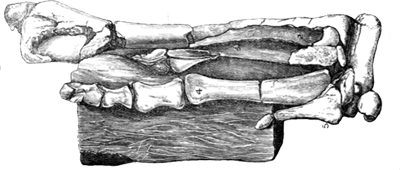
The remains of Hortalotarsus were discovered by Mr. William Hornet Wallace in the Clarens Formation at "Eagle's Crag", near the town of Barkly East (officially renamed Ekhephini in 2026), in the southern Drakensberg region of what was then the Cape of Good Hope (Cape Colony), but is now part of South Africa's Eastern Cape Province, on 11 June 1888. The holotype (AM 455), housed at Albany Museum in Makhanda (formerly Grahamstown), is a partial hindlimb.


