




Pronunciation: PRY-oh-don-TOG-nah-thus
Meaning: Saw tooth jaw
Author/s: Seeley (1875)
Synonyms: Iguanodon phillipsii
First Discovery: Uncertain (Yorkshire?)
Acta Ordinal: #38
Priodontognathus phillipsii
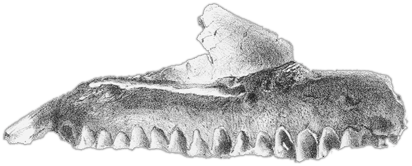
Priodontognathus was initially assigned to Iguanodon as Iguanodon phillipsii by Harry Seeley in 1869, on the strength of a battered lump of maxilla—a tooth?bearing bone from the upper jaw which, at that early stage, appeared to be entirely lacking teeth. Its provenance was no clearer than its dentition: Dr. Forbes-Young had failed to record the locality, leaving later scholars to reconstruct its origins from the general habits of his collecting. As his fossils were mostly from Calcareous Grit and Coral Rag, two possibilities presented themselves: an Upper Jurassic seashore in Yorkshire, or the Lower Cretaceous beds around the town of Hastings in Sussex. The former now seems the sounder guess, despite Seeley’s earnest application of the Victorian lick test—undertaken at the urging of Mr. Etheridge, who maintained that coastal fossils ought to taste of salt—which suggested, by that respectable criterion, that it had not come from a shoreline at all.
By 1875, Seeley had prepared the jaw more thoroughly and uncovered layers of previously hidden replacement teeth with heavily serrated edges—hence the name, meaning "saw-tooth jaw"—and realised that the specimen could not possibly belong to Iguanodon. He remarked upon resemblances in the teeth to Scelidosaurus, Echinodon, and Acanthopholis, and even likened the overall jaw shape to that of a rhinoceros, but ultimately declined to hazard a firm conclusion. Instead, he consigned the problem of its true affinities to future palaeontologists, who have found the matter no less perplexing than he did.
Almost two decades after naming Priodontognathus, Seeley erected the stegosaurian Omosaurus Phillipsi, based on a poorly preserved thigh bone (YM 498) discovered on the Earl of Carlisle's estate at Slingsby, North Yorkshire, in 1838. He deliberately bestowed upon it the same species name as Priodontognathus—albeit capitalised and with one "i" fewer—on the suspicion that the two fossils might one day prove synonymous, despite being wholly non-comparable. Should that come to pass, only the generic name would be sacrificed. Seeley himself did not formally unite them, but many researchers assumed that he had, and from that point onward Priodontognathus was widely treated as a stegosaurian by association alone.
The first serious dissent came from Franz Nopcsa in 1902, who doubted its stegosaurian credentials and instead assigned it to his "Acanthopholididae", now recognised as Nodosauridae. Alfred Romer likewise regarded it as an ankylosaurian in 1956, though he erred in synonymising it with Hylaeosaurus. It fell to Peter Galton in 1980 to transfer Priodontognathus decisively from Stegosauria to Ankylosauria—across the armoured divide from one thyreophoran branch to the other—and specifically into Nodosauridae, thereby vindicating Nopcsa's early intuition. Today, however, Priodontognathus is generally regarded as a dubious ankylosaurian of uncertain affinities. As for Omosaurus, that name had already been claimed by a phytosaur (Omosaurus perplexus, Leidy 1856), so Dacentrurus was adopted as a replacement by Frederic Augustus Lucas in 1902, though only the type species—Dacentrurus armatus—is now considered valid.
By 1875, Seeley had prepared the jaw more thoroughly and uncovered layers of previously hidden replacement teeth with heavily serrated edges—hence the name, meaning "saw-tooth jaw"—and realised that the specimen could not possibly belong to Iguanodon. He remarked upon resemblances in the teeth to Scelidosaurus, Echinodon, and Acanthopholis, and even likened the overall jaw shape to that of a rhinoceros, but ultimately declined to hazard a firm conclusion. Instead, he consigned the problem of its true affinities to future palaeontologists, who have found the matter no less perplexing than he did.
Almost two decades after naming Priodontognathus, Seeley erected the stegosaurian Omosaurus Phillipsi, based on a poorly preserved thigh bone (YM 498) discovered on the Earl of Carlisle's estate at Slingsby, North Yorkshire, in 1838. He deliberately bestowed upon it the same species name as Priodontognathus—albeit capitalised and with one "i" fewer—on the suspicion that the two fossils might one day prove synonymous, despite being wholly non-comparable. Should that come to pass, only the generic name would be sacrificed. Seeley himself did not formally unite them, but many researchers assumed that he had, and from that point onward Priodontognathus was widely treated as a stegosaurian by association alone.
The first serious dissent came from Franz Nopcsa in 1902, who doubted its stegosaurian credentials and instead assigned it to his "Acanthopholididae", now recognised as Nodosauridae. Alfred Romer likewise regarded it as an ankylosaurian in 1956, though he erred in synonymising it with Hylaeosaurus. It fell to Peter Galton in 1980 to transfer Priodontognathus decisively from Stegosauria to Ankylosauria—across the armoured divide from one thyreophoran branch to the other—and specifically into Nodosauridae, thereby vindicating Nopcsa's early intuition. Today, however, Priodontognathus is generally regarded as a dubious ankylosaurian of uncertain affinities. As for Omosaurus, that name had already been claimed by a phytosaur (Omosaurus perplexus, Leidy 1856), so Dacentrurus was adopted as a replacement by Frederic Augustus Lucas in 1902, though only the type species—Dacentrurus armatus—is now considered valid.
(Phillips' saw-tooth jaw)
Etymology
Priodontognathus is derived from the Greek "prion" (saw), "odont-" (tooth) and "gnathos" (jaw), referring to the saw-like edges of its replacement teeth. The species epithet, phillipsii (FIL-ip-see-eye), honours geology professor John Phillips.
Synonyms
Iguanodon phillipsii (Seeley, 1869)
Discovery
The remains of Priodontognathus were discovered in the Calcareous Grit Formation (possibly on the Yorkshire coast), England, United Kingdom, by Dr. James Forbes-Young, whose fossil collection was donated to the University of Cambridge by his sons Charles and Henry Young after his death in 1861.The holotype (SMC B53408) is a left maxilla (a tooth-bearing bone of the upper jaw).


