





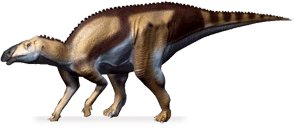
Pronunciation: kun-DUH-ro-SOR-us
Meaning: Kundur lizard
Author/s: Godefroit et al. (2012)
Synonyms: None known
First Discovery: Kundur, Russia
Acta Ordinal: #819
Kundurosaurus nagornyi
Four dinosaur-rich localities have been discovered in the Amur/Heilongjiang region of eastern Asia: Jiayin, Wulaga, Blagoveschensk and Kundur, and all have yielded spectacularly complete fossilised hadrosaurids, including a couple of saurolophines. Unfortunately, Kundurosaurus isn't one of them. It is a saurolophine, but its remains amount to a partial skull, a pelvic girdle and a few isolated bones, though they are in a decent state of preservation and sport enough unique features to set it apart from its contemporaries.
(Nagorny's Kundur lizard)Etymology
Kundurosaurus is derived from "Kundur" (the type-locality) and the Greek "sauros" (lizard).
The species epithet, nagornyi, honours Vladimir A. Nagorny from the Far Eastern Institute of Mineral Resources, for discovering the Kundur locality in 1990.
ZooBank registry: urn:lsid:zoobank.org:act:F0B031EB-B21B-4AEC-B129-6F4BB5DC7F0C.
Discovery
The remains of Kundurosaurus were discovered in the Udurchukan Formation, "Lower Zeya depression" of the Zeya-Bureya sedimentary basin, Kundur, Ahara County, Amur Region, Far Eastern Russia.
The holotype (AENM 2/921) is a partial, disarticulated skull.
Referred material includes more skull fragments, shoulder girdle elements, forelimb bones, and a nearly complete pelvic girdle.


