


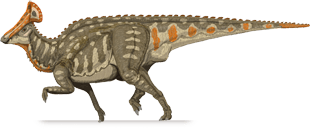
Pronunciation: o-LO-ro-TIE-tuhn
Meaning: Giant swan
Author/s: Godefroit et al. (2003)
Synonyms: None known
First Discovery: Amur, Russia
Acta Ordinal: #531
Olorotitan arharensis
Olorotitan belongs to a tribe of helmet-crested lambeosaurine hadrosaurids known as Lambeosaurini (previously known as Corythosaurini and/or Hypacrosaurini) and represents the most complete dinosaur known from Russia and one of the best-preserved lambeosaurines found outside of western North America to date.
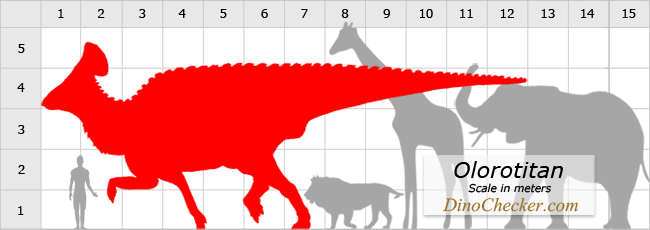
 Cut from the same cloth as North America's Corythosaurus and Hypacrosaurus, Olorotitan is notable for a hollow head crest that flares out at the end and is named for its long neck (Olorotitan means "giant swan") containing 18 vertebrae: three more than the going rate for your average hadrosaur, and ditto for its sacrum. The length and proportions of its arms suggest Olorotitan walked primarily on two legs, although, like most hadrosaurs, it could probably move, or at least graze, on all fours.
Smaller, bipedal, swift-running dinosaurs tend to have longer shins than thighs, while in larger, slower ones, that trend is reversed. The shins of Olorotitan are the same length as its thighs, so while it wasn't breaking any land speed records, it could probably outrun most large hadrosaurs and iguanodonts, which is always handy when a hungry apex predator is in hot pursuit.
Cut from the same cloth as North America's Corythosaurus and Hypacrosaurus, Olorotitan is notable for a hollow head crest that flares out at the end and is named for its long neck (Olorotitan means "giant swan") containing 18 vertebrae: three more than the going rate for your average hadrosaur, and ditto for its sacrum. The length and proportions of its arms suggest Olorotitan walked primarily on two legs, although, like most hadrosaurs, it could probably move, or at least graze, on all fours.
Smaller, bipedal, swift-running dinosaurs tend to have longer shins than thighs, while in larger, slower ones, that trend is reversed. The shins of Olorotitan are the same length as its thighs, so while it wasn't breaking any land speed records, it could probably outrun most large hadrosaurs and iguanodonts, which is always handy when a hungry apex predator is in hot pursuit.
(Giant Swan from Arhara)
Etymology
Olorotitan is derived from the Latin "olor" (swan) and the Greek "Titan" (giant) because of its great size and long "swan-like" neck. The species epithet (or specific name), arharensis, is derived from "Arhara " (for Arhara County where the holotype was found) and the Latin "ensis" (from).
Discovery
The remains of Olorotitan were discovered at the "Kundur locality" in the Udurchukan Formation (Tsagayan Group), Yevreyskaya, Kundur, Amur Region, , Far Eastern Russia, in 1999, and were fully excavated by 2001. The holotype (AEHM 2/845, housed at the Amur Natural History Museum at Blagoveschensk) is a partial skeleton and skull. The Kunder site was discovered in 1990 by Vladimir A. Nagorny (Far Eastern Institute of Mineral Resources,
FEB RAS, Blagoveschensk, Russia), who collected fossil
bones in a road section along the Chita-Khabarovsk highway
near the village of Kundur. He was honored in the epithet of Kundurosaurus nagornyi which was named in 2012.