






Pronunciation: joo-ra-TIE-rant
Meaning: Jurassic tyrant
Author/s: Benson and Brusatte (2013)
Synonyms: Stokesosaurus langhami
First Discovery: Dorset, England
Acta Ordinal: #842
Juratyrant langhami
Discovered in Dorset, England, way back in 1984 and mentioned in passing by several authors since then, the remains that would eventually become Juratyrant weren't officially described until 2008 when Roger Benson identified them as a second species of North America's Stokesosaurus: Stokesosaurus langhami.
Further research revealed that all but one of the four once-thought-unique characteristics linking the two species of Stokesosaurus were actually quite common among tyrannosauroids. Furthermore, as one of the most complete known Jurassic tyrannosauroid fossils, "Stokesosaurus" langhami sports at least four and possibly six unique features that cannot confidently be assessed in other same-aged same-type critters which are known from lesser remains, but the one unique feature that Stokesosaurus clevelandi has left is not one of them.
Given the considerable uncertainty and huge geographical distance between the two species, not to mention the size disparity of their only comparable fossils (a hip bone known as an ilium, which is more than double the size in Stokesosaurus langhami compared to Stokesosaurus clevelandi), Benson wisely assigned Stokesosaurus langhami its own name — Juratyrant — in 2013. Later that year, Loewen and colleagues coined Lythronax and performed a review of tyrant lizards, in which they found Juratyrant to be a proceratosaurid tyrannosauroid closely related to, and forming a subfamily with, North America's Stokesosaurus and China's Sinotyrannus. But that classification is no longer in vogue.
In 2020, Thomas Carr finally satisfied the ICZN's criterion for naming new families by adding a definition and specifics to a group of archaic tyrannosauroid dinosaurs he'd been referencing for years. The now-official Stokesosauridae contains the anchor and namesake Stokesosaurus clevelandi (Madsen, 1974), plus Eotyrannus lengi (Hutt et al., 2001) and Juratyrant langhami (Benson, 2008), probably Tanycolagreus topwilsoni (Carpenter et al., 2005) which is suspected of being a synonym of Stokesosaurus clevelandi, and perhaps Aviatyrannis jurassica (Rauhut, 2003) if it turns out to be a Portuguese species of Stokesosaurus.
Further research revealed that all but one of the four once-thought-unique characteristics linking the two species of Stokesosaurus were actually quite common among tyrannosauroids. Furthermore, as one of the most complete known Jurassic tyrannosauroid fossils, "Stokesosaurus" langhami sports at least four and possibly six unique features that cannot confidently be assessed in other same-aged same-type critters which are known from lesser remains, but the one unique feature that Stokesosaurus clevelandi has left is not one of them.
Given the considerable uncertainty and huge geographical distance between the two species, not to mention the size disparity of their only comparable fossils (a hip bone known as an ilium, which is more than double the size in Stokesosaurus langhami compared to Stokesosaurus clevelandi), Benson wisely assigned Stokesosaurus langhami its own name — Juratyrant — in 2013. Later that year, Loewen and colleagues coined Lythronax and performed a review of tyrant lizards, in which they found Juratyrant to be a proceratosaurid tyrannosauroid closely related to, and forming a subfamily with, North America's Stokesosaurus and China's Sinotyrannus. But that classification is no longer in vogue.
In 2020, Thomas Carr finally satisfied the ICZN's criterion for naming new families by adding a definition and specifics to a group of archaic tyrannosauroid dinosaurs he'd been referencing for years. The now-official Stokesosauridae contains the anchor and namesake Stokesosaurus clevelandi (Madsen, 1974), plus Eotyrannus lengi (Hutt et al., 2001) and Juratyrant langhami (Benson, 2008), probably Tanycolagreus topwilsoni (Carpenter et al., 2005) which is suspected of being a synonym of Stokesosaurus clevelandi, and perhaps Aviatyrannis jurassica (Rauhut, 2003) if it turns out to be a Portuguese species of Stokesosaurus.
Etymology
Juratyrant is derived from "Jura" (a reference to its Jurassic age) and "tyrant" (anglicised form of the Greek "tyrannos"—an illegitimately self-appointed ruler—referring to tyrannosauroids which, based on the original etymology of Tyrannosaurus, are known colloquially as "tyrant lizards").
The species epithet, langhami, honours commercial fossil collector Peter Langham of Bridport, Dorset, who discovered its remains.
Discovery
The remains of Juratyrant were discovered in the Kimmeridge Clay of Dorset, 6 miles west of Swanage between Rope Lake Head
and Freshwater Steps, by Peter Langham in 1984.
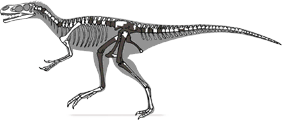
The holotype (OUMNH J.3311-1--J.3311-30) is partial skeleton, including a neck vertebra, five back vertebrae, a complete block of pelvic vertebrae, five tail vertebrae, a complete pelvic girdle, both thighs, both shins, and an unidentified bone fragment, found within an area of approximately three square metres.
Preparators
D. Kemp of Oxford.


