




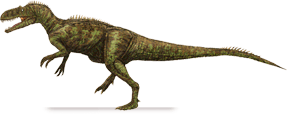
Pronunciation: chee-LAHN-tai-SOR-us
Meaning: Jilantai lizard
Author/s: Hu (1964)
Synonyms: None known
First Discovery: Nei Mongol, China
Acta Ordinal: #216
Chilantaisaurus tashuikouensis
Named in 1964 by Hu Show-Yung (not to be confused with Chinese botanist Hu Shiu-Ying, who died on 22 May 2012 at the ripe old age of 102), Chilantaisaurus tashuikouensis is based on a partial skeleton from Inner Mongolia's Ulansuhai Formation. The length of its thighbones suggest a colossal individual, comparable in size to the largest theropod dinosaurs. Yet its classification is far from clear-cut, as a weird mosaic of features, seemingly cherry-picked from across the theropod family tree, has given palaeontologists the runaround for years.
In the decades following its description, Chilantaisaurus was allied with allosauroids (Harris, 1998), megalosauroids (Rauhut, 2003) and neotetanurans (Benson and Xu, 2008), brushed off as a tetanuran of uncertain affinities (Holtz, 2004), and compared to a plethora of carnivorous critters from all places and times. At one point, it was even synonymized with Alectrosaurus olseni. But the latter was based on its similarities to the original Alectrosaurus material which, as it turns out, belongs to a therizinosaur (Nessov 1995).
In 2010, Roger Benson, Matt Carrano and Steve Brusatte realised that many of the quirks found in Chilantaisaurus were present in other problematic theropods like Neovenator and Australovenator too, so they bunched them all into one family—Neovenatoridae. Ironically, while Neovenatoridae means "new hunters", many of them are quite ancient—and some may not belong there at all. As of 2012, Chilantaisaurus itself was still under scrutiny, with at least one expert proposing its inclusion among the sail-backed piscivores known as spinosaurids. Meanwhile, several analyses have concluded that a neovenatorid subgroup—the megaraptorans—may in fact be tyrannosauroids, potentially placing them closer to Tyrannosaurus rex than anyone expected.
In the decades following its description, Chilantaisaurus was allied with allosauroids (Harris, 1998), megalosauroids (Rauhut, 2003) and neotetanurans (Benson and Xu, 2008), brushed off as a tetanuran of uncertain affinities (Holtz, 2004), and compared to a plethora of carnivorous critters from all places and times. At one point, it was even synonymized with Alectrosaurus olseni. But the latter was based on its similarities to the original Alectrosaurus material which, as it turns out, belongs to a therizinosaur (Nessov 1995).
In 2010, Roger Benson, Matt Carrano and Steve Brusatte realised that many of the quirks found in Chilantaisaurus were present in other problematic theropods like Neovenator and Australovenator too, so they bunched them all into one family—Neovenatoridae. Ironically, while Neovenatoridae means "new hunters", many of them are quite ancient—and some may not belong there at all. As of 2012, Chilantaisaurus itself was still under scrutiny, with at least one expert proposing its inclusion among the sail-backed piscivores known as spinosaurids. Meanwhile, several analyses have concluded that a neovenatorid subgroup—the megaraptorans—may in fact be tyrannosauroids, potentially placing them closer to Tyrannosaurus rex than anyone expected.
Etymology
Chilantaisaurus is derived from "Chilantai" (anglicized form of the Chinese "Jilantai"—a salt lake near its place of discovery) and the Greek "sauros" (lizard).
The species epithet, tashuikouensis, means "from Tashuikou" in Latin.
Discovery
Chilantaisaurus was discovered in the Ulansuhai Formation at Tashuikou (aka Dashuigou, "Big Water Gully"), 60 km north of Chilantai in Alanshan, Inner Mongolia, China, in 1960.
In 2008, Benson and Xu cast suspicious glances at some of the fossils originally assigned to Chilantaisaurus by Hu in 1964. For stability, they selected a right upper arm (IVPP V.2884.1, 580 mm long) from Hu's original holotype as the lectotype—a single specimen chosen from a multi-element holotype to officially represent the species.
The remaining original fossils became paralectotypes. These include:
IVPP V.2884.2, a hand claw (ungual phalanx)
IVPP V.2884.3, a fragment of the left hip (ilium)
IVPP V.2884.4, left and right thigh bones (femora), 1190 mm long
IVPP V.2884.5, right and partial left shin bones (tibiae), 954 mm long
IVPP V.2884.6, a partial left lower leg bone (fibula)
IVPP V.2884.7, foot bones (metatarsals): right II (415 mm long), III (460 mm long), and IV (365 mm long), plus left III and IV. An isolated tooth (IVPP V.2884.8) and two partial tail vertebrae were found with the holotype and described by Hu as "probably belonging to the same species". Later studies showed that one vertebra came from a sauropod, the other had no diagnostic features, and the tooth has since been lost.


