








Pronunciation: eh-ro-stee-on
Meaning: Air bone
Author/s: Sereno, Martinez, et al. (2009)
Synonyms: None known
First Discovery: Neuquén, Argentina
Acta Ordinal: #692
Aerosteon riocoloradensis
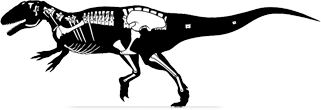
An allosauroid, specifically a neovenatorid allosauroid, and more specifically a megaraptoran neovenatorid allosauroid (though a position in Tyrannoauridae has recently been mooted), Aerosteon was a big boy at around nine meters in length, but was a bit of a lightweight because of what bods call "extensive pneumatization"—air holes in its bones—which prompted a bit of argy-bargy between lead author Paul Sereno and Matt Wedel. We won't bore you with details, link suffice to say no punches were pulled during heated back and forth exchanges as the pair puffed their chests out. And speaking of puffing chests out; apparently Aerosteon couldn't because, unlike mammals, theropods had rigid lungs, so they needed another way to breathe.
In a manner similar to modern birds, Aerosteon's breathing seems to have been undertaken by a series of air sacks in its thorax and abdomen that bellowed air in a one way stream through a pair of fairly rigid lungs. The name-prompting "pneumaticity" was caused by outpockets of said air sacks invading the surrounding bones, thus reducing their weight. In birds, this bellow or "flow-through" system also provides a continuous airflow to power the insane metabolic rate required for powered flight.
(Air bone from Rio Colorado)
Etymology
Aerosteon is derived from the Greek "aeros" (air) and "osteon" (bone) because of what bods call "pneumatized" bones; cavities in some of its bones, like the bubbles in an "Aero" chocolate bar, which would have been filled with air from invading air sacks attached fore and aft to its lungs. The species epithet, riocoloradensis, means "from Rio Colorado" in Latin. However, adjectives ending in "-ensis" may be either masculine or feminine but they can't be neuter (Latin = "of neither sex"), and as the Greek "osteon" is neuter gender the epithet must be neuter also. Therefore, the correct epithet should be riocoloradense.ref
Discovery
The remains of Aerosteon were discovered at Cañadon Amarillo in the Anacleto Formation, (Neuquén Group, Río Colorado Subgroup), 1 km north of the Río Colorado near the
southern border of Mendoza Province, Argentina, in 1996.The holotype (MCNA-PV-3137) is a partial skeleton, including skull bones, twenty vertebrae from the neck, back, hip and tail, back ribs, "belly ribs" (gastralia), a left shoulder girdle, and pelvic bones (left ilium, and right and left pubes). An isolated tooth crown initially included in the holotype turned out to be the property of an abelisaurid theropod.


