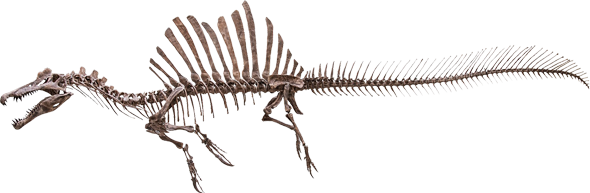
a fish-eating spinosaurid theropod dinosaur from the Early Cretaceous of North Africa.
Pronunciation: SPIEN-oh-SOR-us
Meaning: Spined lizard
Author/s: Ernst Stromer (
1915)
Synonyms: See
below
First Discovery: Marsa Matruh, Egypt
Acta Ordinal: #120
Spinosaurus aegyptiacus
Since its discovery in Egypt's Baharija Formation in 1912, Spinosaurus has been a top contender for longest and largest theropod dinosaur ever. Unfortunately, whatever fossils weren't lost or broken during clumsy transit to Germany's Munich museum were blown to hell by WW2 allied bombing raids in 1944, and all that was left were some tantalising photos by Ernst Stromer who later envisioned Spinosaurus as a sail-backed, piscivorous biped of epic proportions.
(Spined Lizard from Egypt)Etymology
Spinosaurus is derived from the Latin "spina" (spine) and the Greek "sauros" (lizard) because of the large paddle-like spines raised along its back.
The
species epithet,
aegyptiacus, refers to its discovery in Egypt.
Spinosaurus maroccanus?
(Russell, 1996)
Sigilmassasaurus brevicollis?
(Russell, 1996)
Oxalaia quilombensis?
(Kellner
et al., 2011)
Discovery
The first recognised fossils of
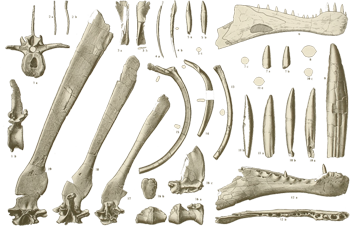
Spinosaurus were discovered in the Baharija Formation at Baharija Oasis, Marsa Matruh, Egypt, by Richard Markgraf, a collector for German palaeontologist Ernst Stromer, in the Spring of 1912.
The
holotype (BSP 1912 VIII 19) is a partial skeleton including neck (2), hip (3) and tail (1) vertebrae, seven name-prompting spined back vertebrae, ribs, a partial lower jaw, a small piece of upper jaw, teeth and other fragments, many of which fell apart during washing and had to be glued back together.
These remains were destroyed during WWII bombing raids on Munich during the 24th-25th of April 1944, so in 2014 Ibrahim nominated a partial skeleton (FSAC-KK 11888), found by a local collector in 2008 in what turned out to be the Douira Formation near Al Gualb Mesa, as the neotype (new type), meaning the spined lizard from Egypt would have been anchored by remains from Morroco. However, Evers and colleagues rejected the neotype designation in 2015.
The earliest possible discovery of
Spinosaurus occurred in October 1898, when French geologist Fernand Foureau uncovered two unusual teeth in Cenomanian sediments of the Djoua Escarpment in what is now southern Algeria, during the Foureau-Lamy Expedition (1898–1900) across the Sahara. In 1905, geologist Émile Haug described the expedition's fossils and assigned the teeth to the fish
Saurocephalus. In 1915, Ernst Stromer reidentified them as belonging to
Spinosaurus, a conclusion later studies have supported, even though the teeth themselves have since been lost.
Based on a single, 19.5cm long mid-neck vertebra (NMC 50791, held by the Canadian Museum of Nature) from the Kem Kem Beds of Morocco, Dale Russell named
in 1996. In 2014, Nizar Ibrahim
. tagged it a nomen dubium.
• Haug E (1905) "Paleontologie".
Documents Scientifiques de la Mission Saharienne. 2. Masson, Paris: 751–832.
• Stromer E (1915) "Ergebnisse der Forschungsreisen Prof. E. Stromers in den Wüsten
Ägyptens. II. Wirbeltier-Reste der Baharîje-Stufe (unterstes Cenoman). 3. Das Original des Theropoden Spinosaurus aegyptiacus nov. gen., nov. spec." [
Results of Prof. E. Stromer's Research Expedition in the Deserts of Egypt II. Vertebrate Remains from the Baharîje Beds (lowermost Cenomanian)
3. The Type of the Theropod Spinosaurus aegyptiacus
nov. gen., nov. spec.].
Abhandlungen der Königlichen Bayerischen Akademie der Wissenschaften, Mathematisch-physikalische Klasse, 28(3): 1-32. [English Translation by R.T. Zanon, 1989.] 
• Stromer E (1936) "Ergebnisse der Forschungsreisen Prof. E. Stromers in den Wüsten Ägyptens. VII. Baharîje Kessel
und Stufe mit deren Fauna und Flora. Eine ergänzende Zusammenfassung".
Abhandlungen der Bayerischen
Akademie der Wissenschaften Mathematisch Naturwissenschaftliche Abteilung, 33: 1–102.
• Russell DA (1996) "Isolated dinosaur bones from the Middle Cretaceous of the Tafilalt, Morocco".
Bulletin du Museum National d'Histoire Naturelle Section C Sciences de la Terre Paleontologie Geologie Mineralogie, 18(2-3): 349-402.
• Taquet P and Russell DA (1998) "New data on spinosaurid dinosaurs from the Early Cretaceous of the Sahara".
Comptes Rendus de l'Académie des Sciences - Series IIA - Earth and Planetary Science, 327(5): 347-353. DOI: 10.1016/S1251-8050(98)80054-2.
• Buffetaut E and Ouaja M (2002) "
A new specimen of Spinosaurus (Dinosauria, Theropoda) from the Lower Cretaceous of Tunisia, with remarks on the evolutionary history of the Spinosauridae".
Bulletin de la Société Géologique de France, 173(5): 415-421.
DOI: 10.2113/173.5.415.
• Holtz TR jr, Molnar RE and Currie PJ (2004) "Basal Tetanurae" in Weishampel, Dodson and Osmólska's "
The Dinosauria: Second Edition".
• dal Sasso C, Maganuco S, Buffetaut E, Mendez MA (2005) "
New information on the skull of the enigmatic theropod Spinosaurus, with remarks on its sizes and affinities".
Journal of Vertebrate Paleontology, 25:4, 888-896. DOI: 10.1671/0272-4634(2005)025[0888:NIOTSO]2.0.CO;2.
• Smith JB, Lamanna MC, Mayr H and Lacovara KJ (2006) "
New information regarding the holotype of Spinosaurus aegyptiacus Stromer, 1915".
Journal of Paleontology 80(2): 400-406. DOI: 10.1666/0022-3360(2006)080[0400:NIRTHO]2.0.CO;2.
• Amiot R, Buffetaut E, Lécuyer C, Wang X, Hutt S, Boudad L, Ding Z, Fourel F, Sweetman Martineau SF, Medeiros A, Mo J, Simon L, Suteethorn V, Zhou Z, Tong H and Zhang F (2010) "Oxygen isotope evidence for semi-aquatic habits among spinosaurid theropods".
Geology (2010) 38(2): 139-142.
DOI: 10.1130/G30402.1.
• Buffetaut É (2010) "Spinosaurs before Stromer: early finds of spinosaurid dinosaurs and their interpretations". Page 175-188 in Moody, Buffetaut, Naish and Martill (eds.) "Dinosaurs and Other Extinct Saurians: A Historical Perspective".
• Ibrahim N, Sereno PC, Dal Sasso C, Maganuco S, Fabbri M, Martill DM, Zouhri S, Myhrvold N and Iurino DA (2014) "Semiaquatic adaptations in a giant predatory dinosaur".
Science, 345(6204): 1613-1616. DOI: 10.1126/science.1258750.
• Henderson DM (2018) "A buoyancy, balance and stability challenge to the hypothesis of a semi-aquatic
Spinosaurus Stromer, 1915 (Dinosauria: Theropoda)".
PeerJ 6(2): e5409. DOI: 10.7717/peerj.5409
• Ibrahim N, Sereno PC, Varricchio DJ, Martill DM, Dutheil DB, Unwin DM, Baidder L, Larsson HCE, Zouhri S and Kaoukaya A (2020) "Geology and paleontology of the Upper Cretaceous Kem Kem Group of eastern Morocco".
ZooKeys, 928: 1-216.
DOI: 10.3897/zookeys.928.47517.
• Hone DWE and Holtz TR Jr (2021) "Evaluating the ecology of
Spinosaurus: Shoreline generalist or aquatic pursuit specialist".
Palaeontologica Electronica 24(1): a03. DOI: 10.26879/1110.
• Fabbri M, Navalón G, Benson RBJ, Pol D, O'Connor J, Bhullar B-AS, Erickson GM, Norell MA, Orkney A, Lamanna MC, Zouhri S, Becker J, Emke A, Dal Sasso C, Bindellini G, Maganuco S, Auditore M and Ibrahim N (2022)
"Subaqueous foraging among carnivorous dinosaurs".
Nature (advance online publication)
DOI: 10.1038/s41586-022-04528-0.
• Myhrvold NP, Sereno PC, Baumgart SL, Formoso KK, Vidal D, Fish FE and Henderson DM (2022) "Spinosaurids as 'subaqueous foragers' undermined by selective sampling and problematic statistical inference".
bioRxiv 2022.04.13.487781 (preprint).
DOI: 10.1101/2022.04.13.487781.
• Sereno PC, Myhrvold N, Henderson DM, Fish FE, Vidal D, Baumgart SL, Keillor TM, Kiersten K. Formoso KK and Conroy LL (2022) "
Spinosaurus is not an aquatic dinosaur".
bioRxiv 2022.05.25.493395 (preprint). DOI: 10.1101/2022.05.25.493395.
• Yun C-G (2023) "Spinosaurs as phytosaur mimics: a case of convergent evolution between two extinct archosauriform clades".
Acta Palaeontologica Romaniae, 20(1): 17-29. DOI: 10.35463/j.apr.2024.01.02.
• Liu Z, Prendergast AL, Drysdale R, Long K and May J-H (2025)
"The effectiveness of oxygen isotopes in
Spinosaurus tooth dentine for high-resolution palaeoenvironmental reconstructions".
Palaeogeography, Palaeoclimatology, Palaeoecology: 112908.
DOI: https://doi.org/10.1016/j.palaeo.2025.112908.