





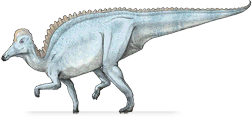
Pronunciation: a-MOO-uhr-o-SOR-us
Meaning: Amur River lizard
Author/s: Bolotsky and Kurzanov (1991)
Synonyms: None known
First Discovery: Blagoveschensk, Russia
Acta Ordinal: #363
Amurosaurus riabinini
The remains that would become Amurosaurus were discovered at a large site in the Udurchukan Formation at Blagoveschensk - the Tsagayan Group's oldest formation - in 1984. Although a mere 200m² area had been excavated by 1991, dinosaur bones had been found in their hundreds, 90% of them lambeosaurine, so it's a little suprising that Yuri L. Bolotsky chose partial jaws as the holotype when he coined the name later that year, and that his description was so brief. Since then, no-one gave these copious remains so much as a second glance, and Amurosaurus remained obscure and ignored until 2004. Even Asian ornithopod experts gave it the cold shoulder.
In cahoots with Godefroit and Itterbeeck, Bolotsky revisited the Blagoveschensk bone pile in 2004 and realised that many of the bones belonged to Amurosuarus, albeit seperate individuals, and it instantly became the most abundantly known dinosaur ever discovered on Russian territory. On top of that the age of the Udurchukan Formation bodes well for the "Asian origin for lambeosaurines" hypothesis, and experts surmise that these duck-billed critters and other Asian vertebrate groups travelled across the Beringian isthmus into western North America via a land route that may have opened during the Aptian–Albian and persisted during the Late Cretaceous.
 Often listed as a member of Corythosaurini—the helmet-crested lambeosaurines—the shape of the Amurosaurus crest, or if it even had one, is unknown. What is clear, however, is that its lower jaw was built to take a huge M. pseudotemporalis—the muscle that powers chewing—and that its jaws were packed with replaceable teeth, 37 in the holotype lower jaw and 39 in the upper, arranged in colums 4-5 teeth-deep. A replica of Amurosaurus is on display at Brussel's Museum of Natural Sciences alongside a swan, which is nice.
In cahoots with Godefroit and Itterbeeck, Bolotsky revisited the Blagoveschensk bone pile in 2004 and realised that many of the bones belonged to Amurosuarus, albeit seperate individuals, and it instantly became the most abundantly known dinosaur ever discovered on Russian territory. On top of that the age of the Udurchukan Formation bodes well for the "Asian origin for lambeosaurines" hypothesis, and experts surmise that these duck-billed critters and other Asian vertebrate groups travelled across the Beringian isthmus into western North America via a land route that may have opened during the Aptian–Albian and persisted during the Late Cretaceous.
Often listed as a member of Corythosaurini—the helmet-crested lambeosaurines—the shape of the Amurosaurus crest, or if it even had one, is unknown. What is clear, however, is that its lower jaw was built to take a huge M. pseudotemporalis—the muscle that powers chewing—and that its jaws were packed with replaceable teeth, 37 in the holotype lower jaw and 39 in the upper, arranged in colums 4-5 teeth-deep. A replica of Amurosaurus is on display at Brussel's Museum of Natural Sciences alongside a swan, which is nice.
(Riabinin's Amur River Lizard)Etymology
Amurosaurus is derived from "Amur" (for the Amur River) and the Greek "sauros" (lizard). The species epithet (riabinini) is named in honor of late Russian paleontologist Anatoly Riabinin, who led the first Russian dino expeditions to the Amur region in 1916 and 1917.
Discovery
The remains of Amurosaurus were discovered in the Udurchukan Formation, upper Nagornaia Street, Blagoveschensk, in the Amur Oblast of Far Eastern Russia, by Yuri L. Bolotsky and the Amur Complex Integrated Research Institute in 1984. The holotype (AEHM 1/12) is a maxilla (upper jaw bone), and a dentary (lower jaw bone), both from the left side, but most of the skeleton is now known thanks to donations from many individuals.


