









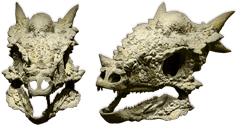
Pronunciation: STIG-ee-MO-lock
Meaning: Styx demon
Author/s: Galton and Sues (1983)
Synonyms: Stenotholus kohleri (Giffin et al., 1987)
First Discovery: Montana, USA
Acta Ordinal: #313
Stygimoloch spinifer
With a name that roughly translates as "horned demon from the river of death", you could be forgiven for expecting a demeanour to match, and the fact it was unearthed in Hell Creek only adds to the anticipation. We know you want us to tell you that Stygimoloch were merciless carnivores cutting a swathe through landscapes full of poor defenceless herbivores. But, the truth is, they were probably just as poor and defenceless themselves.
At a mere three meters long and 2-to-300 pounds, Stygimoloch wasn't big enough to do any real damage. And their bony domed skulls, although adorned with massive, low-angled and nasty-looking horns and clusters of smaller bony nodes, were neither tough enough nor the ideal shape for ritual head-butting. However, multiple nasal protrusions would certainly increase the pain factor during bouts of flank butting for the right to bang uglies with the tribe's most desirable females. That is the way pachycephalosaurids did things, and we say: "Bring it on!"
Despite the recent trend of "Pachy-lumping" and almost all palaeontologist's insistence that Stygimoloch is merely the troubled-teenage version of Pachycephalosaurus, we cling to a thread-like hope that future discoveries will reveal some kind of deep and dark secret befitting of Stygimoloch's almost eerily-grinning skull. But until then, will sate our lust for violent dinosaurs with thoughts of Stygimoloch mercilessly pulling leaves from innocent little trees. Rrraaagghhhh.
At a mere three meters long and 2-to-300 pounds, Stygimoloch wasn't big enough to do any real damage. And their bony domed skulls, although adorned with massive, low-angled and nasty-looking horns and clusters of smaller bony nodes, were neither tough enough nor the ideal shape for ritual head-butting. However, multiple nasal protrusions would certainly increase the pain factor during bouts of flank butting for the right to bang uglies with the tribe's most desirable females. That is the way pachycephalosaurids did things, and we say: "Bring it on!"
Despite the recent trend of "Pachy-lumping" and almost all palaeontologist's insistence that Stygimoloch is merely the troubled-teenage version of Pachycephalosaurus, we cling to a thread-like hope that future discoveries will reveal some kind of deep and dark secret befitting of Stygimoloch's almost eerily-grinning skull. But until then, will sate our lust for violent dinosaurs with thoughts of Stygimoloch mercilessly pulling leaves from innocent little trees. Rrraaagghhhh.
(Horned demon from the River of Death)Etymology
Stygimoloch is derived from the Greek "Styx" (the mythical river over which Charon would ferry shades to Hades, alluding to the Hell Creek fomation in which it was found) and the Hebrew "moloch" (demon or horrid king).
The species epithet, spinfer, is derived from the Latin "spina" (thorn) and "fero" (to bear), referring to the spiky horns that adorn its skull.
Discovery
The name-bearing fossils of Stygimoloch were discovered in the Hell Creek Formation at Harbicht Hill, McCone County, Montana, USA. The holotype (UCMP 119433), discovered in 1983, is a skull bone (left squamosal) with horns.
Referred material: YPM 335, a skull bone (fragment of right squamosal) from Wyoming's Lance Formation that O. C. Marsh described as an armour plate belonging to Triceratops in 1896 and that Brown and Schlaikjer assigned to Pachycephalosaurus sp. in 1943.
AMNH 2154 (a partial skull and skeleton), found by Barnum Brown in the Hell Creek Formation of Garfield County, Montana, 0.4 km from the AMNH 5029 Tyrannosaurus Quarry, in 1908.
UCMP 128383 (a partial skull), found by Jennifer Woodcock in the Hell Creek Formation of Garfield County, Montana, in 1983.
MPM 7111 (a partial skull), found by a field crew from the Milwaukee Public Museum in the Hell Creek Formation of McCone County, Montana, in 1985. It was initially named Stenotholus kohleri (Terry and Mary Kohler's narrow dome) by Emily Giffin and colleagues in 1987.
MPM 8111 (a partial skull), found by Jeff Howe in the Hell Creek Formation at Marmarth, Slope County, North Dakota, in 1987.
UCMP 131163 (a partial skull), found by Harley Garbani in the Hell Creek Formation, Garfield County, Montana, in 1987.
UCMP 147063 (a juvenile skull dome) from the Hell Creek Formation, Carter County, Montana.
UCMP 147258 (a horn fragment) from the Lance Formation, Niobrara County, Wyoming.
UW 26525, a skull bone (a partial left squamosal), collected from the Ferris Formation in Wyoming during the summer of 1995, is the southernmost record of Stygimoloch, extending the geographic range 100 km to the south from the Lance Formation in eastern Wyoming. It was collected from deposits that accumulated approximately 320 kyr before the K/Pg boundary, bolstering the hypothesis that Stygimoloch is taxonomically distinct from Pachycephalosaurus wyomingensis.


