




Pronunciation: HWAH-YAHNG-o-SOR-us
Meaning: Huayang lizard
Author/s: Dong, Tang and Zhou (1982)
Synonyms: None known
First Discovery: Sichuan, China
Acta Ordinal: #301
Huayangosaurus taibaii
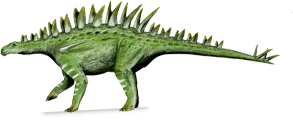
Huayangosaurus is the oldest and most primitive of the stegosaurs or "roof lizards"—the plated branch of the armoured dinosaurs known collectively as Tyreophora. Although one of the smallest of its kind at just over four meters long and less than a ton in weight, its legs are unusually long in proportion to its body, and it crammed more plates and prickly bits into its meagre frame than you could shake a stick at.
Its plates, which ran in two rows from neck to tail, were thicker and more spike-like than those found on its later living relatives, and longest and spikiest over its hips. It had a half meter long, backwards-pointing spike jutting out from each shoulder too, plus a modest horn on the midline of its skull roof, just beyond the eye sockets. And just for good measure, it sported the great equaliser; a thagomizer of four spikes on the end of a muscular tail that it used to tell Mid-Jurassic China's largest predator, Gasosaurus, that it really wasn't a safe menu option.
In contrast to the long, thin and narrow skull of most other stegosaurs, the skull of Huayangosaurus is short, robust and rather wide when viewed from above, which is typical of the other branch of thyreophorans—the ankylosaurs, as are the bony struts that reinforced its tail. These seemingly convergent features suggest Huayangosaurus may have evolved at the crossroads where ankylosaurs and stegosaurs went their separate ways, and be the ancestor of all roof lizards because of its many "primitive" features, another of which is the presence of front teeth. All of the later-living, more "advanced" stegosaurs lost theirs and developed a beak-tipped mouth for shearing tough vegetation.
Its plates, which ran in two rows from neck to tail, were thicker and more spike-like than those found on its later living relatives, and longest and spikiest over its hips. It had a half meter long, backwards-pointing spike jutting out from each shoulder too, plus a modest horn on the midline of its skull roof, just beyond the eye sockets. And just for good measure, it sported the great equaliser; a thagomizer of four spikes on the end of a muscular tail that it used to tell Mid-Jurassic China's largest predator, Gasosaurus, that it really wasn't a safe menu option.
In contrast to the long, thin and narrow skull of most other stegosaurs, the skull of Huayangosaurus is short, robust and rather wide when viewed from above, which is typical of the other branch of thyreophorans—the ankylosaurs, as are the bony struts that reinforced its tail. These seemingly convergent features suggest Huayangosaurus may have evolved at the crossroads where ankylosaurs and stegosaurs went their separate ways, and be the ancestor of all roof lizards because of its many "primitive" features, another of which is the presence of front teeth. All of the later-living, more "advanced" stegosaurs lost theirs and developed a beak-tipped mouth for shearing tough vegetation.
Etymology
Huayangosaurus is named after a book. You don't see that very often! The name is derived from Hua Yang Guo Zhi ("About the lands south of Mt. Hua", which was written by Chang Qu during the Western Jin dynasty—265–316 mya—when Sichuan Province was known as Huayang) and the Greek "sauros" (lizard).The species epithet, taibaii, is named for the zì (a name given or adopted by a Chinese male when he reaches 20 years of age) of Chinese Poet Li Bai. Tai bai means "Great White", which is apparently a reference to the Planet Venus.
Discovery
The fossils of Huayangosaurus were discovered at Dashanpu Dinosaur Quarry in the Lower Shaximiao (Xiashaximiao) Formation, 11km east of Zigong City, Sichuan Province, China.
This area has also yielded remains of Gasosaurus, Omeisaurus, Szechuanosaurus, Xiaosaurus, Datousaurus, Protognathosaurus and Agilisaurus.The holotype (IVPP V.6728) includes a complete skull, three neck, three back, four hip, and twenty tail vertebrae, three plates, some scutes, a spike, and bones from the toes and fingers, but virtually the entire skeleton is known thanks to a dozen individuals from the same quarry.


