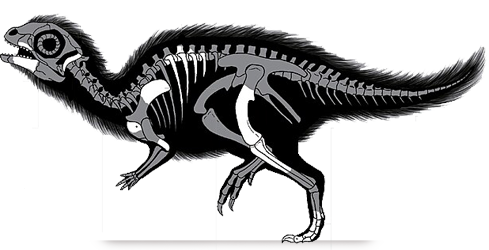
a plant-eating thescelosaurid ornithischian dinosaur from the Mid-Cretaceous of Korea.
Pronunciation: DOO-lee-SOR-us
Meaning: Dooly lizard
Author/s: Jung
et al. (
2026)
Synonyms: None known
First Discovery: Shinan, Republic of Korea
Acta Ordinal: #1229
Doolysaurus huhmini
The Korean dinosaur record is famously lopsided, with footprints and eggs outnumbering bones by orders of magnitude because skeletal remains are exceedingly rare. Against that backdrop of scarcity,
Doolysaurus huhmini stands out as a landmark find: the first Korean dinosaur preserved with diagnostic skull material, the second non-ceratopsian neornithischian named from the peninsula after
Koreanosaurus, and only the third universally accepted dinosaur of any stamp formally named from Korea.
(Min Huh's Dooly Lizard)Etymology
Doolysaurus is derived from "Dooly" (for "Dooly the Little Dinosaur", an iconic Korean baby dinosaur character created by cartoonist Soo-Jung Kim in 1983) and the Greek "sauros" (lizard).
The
species epithet,
huhmini, honours Professor Dr. Min Huh, a palaeontologist who conducted research on a theropod fossil nest from the Aphaedo site, in recognition of his outstanding contributions to the study of dinosaurs in Korea over the past 30 years.
ZooBank registry:
urn:lsid:zoobank.org:act:895C6714-B565-4100-BE78-0F6AFE1537FE.
Discovery
The remains of
Doolysaurus were discovered in the Ilseongsan Formation on the southeastern coast of Aphae Island (Aphaedo), Shinan, Republic of Korea, by Hyemin Jo in 2023.
The
holotype (KDRC-SA-V001, housed in the Korea Dinosaur Research Center of the Chonnam National University) is a juvenile specimen consisting of a partial skull, a possible shoulder girdle and partial upper arm, three back vertebrae, ribs, a left hindlimb including the thigh, shin, calf, foot bones and toes, and gastroliths—stones that are swallowed by critters with a weak gizzard to help grind fodder.
Preparators
Jieun Park of Chonnam National University.
• Chang KH, Seo SJ and Park SO (1982) "Occurrence of a Dinosaur Limb Bone near Tabni, Southern Korea".
Journal of Geological Society of Korea 18: 195–202. DOI: 10.14770/jgsk.1982.18.4.195.
• Kim HM (1983) "Cretaceous Dinosaurs from Korea".
Journal of Geological Society of Korea, 19: 115–126. DOI: 10.14770/jgsk.1983.19.3.115.
• Lee Y-N and Yang SY (1997) "Sauropod dinosaur remains from the Gyeongsang Supergroup, Korea".
Paleontological Society of Korea, Special Publication, 2: 103–114.
• Baek KS and Seo SJ (1998) "Dinosaur's footprints of lower Cretaceous Jindong Formation in Donghae-myeon, Goseong-gun, Gyeongnam, Korea".
Journal of the Paleontological Society of Korea, 14: 81–98. (in Korean with English abstract).
• Paik IS (2000) "Bone chip-filled burrows associated with bored dinosaur bone in floodplain paleosols of the Cretaceous Hasandong Formation, Korea".
Palaeogeography, Palaeoclimatology, Palaeoecology, 157: 213–225. DOI: 10.1016/S0031-0182(99)00166-2.
• Paik IS, Huh M and Kim HJ (2004) "Dinosaur egg-bearing deposits (Upper Cretaceous) of Boseong, Korea: occurrence, palaeoenvironments, taphonomy, and preservation".
Palaeogeography, Palaeoclimatology, Palaeoecology, 205: 155-168. DOI: 10.1016/j.palaeo.2003.12.007.
• Lockley M, Houck K, Yang S-Y, Matsukawa M and Lim S-K (2006) "Dinosaur-dominated footprint assemblages from the Cretaceous Jindong Formation, Hallyo Haesang National Park area, Goseong County, South Korea: Evidence and implications".
Cretaceous Research, 27(1): 70-101.
DOI: 10.1016/j.cretres.2005.10.010.
• Lee Y-N and Lee H-J (2006) "
A Sauropod Trackway in Donghae-myeon, Goseong County, south Gyeongsang Province, Korea and its paleobiological implications of Uhangri manus-only sauropod tracks".
Proceedings of the 2006 Goseong International Dinosaur Symposium. Journal of the Paleontological Society of Korea, 22(1): 1-14.
•
Lee YN, Ryan MJ and Kobayashi Y (2011) "The first ceratopsian dinosaur from South Korea".
Naturwissenschaften 98: 39–49. DOI: 10.1007/s00114-010-0739-y. [Koreaceratops hwaseongensis.]
• Huh M, Lee D-G, Kim J-K, Lim J-D and Godefroit P (2011) "A new basal ornithopod dinosaur from the Upper Cretaceous of South Korea".
Neues Jahrbuch für Geologie und Paläontologie - Abhandlungen, 259: 1-24. DOI: 10.1127/0077-7749/2010/0102. [Koreanosaurus boseongensis.]
• Huh M, Kim BS, Woo Y, Simon DJ, Paik IS and Kim HJ (2014) "First record of a complete giant theropod egg clutch from Upper Cretaceous deposits, South Korea".
Historical Biology, 26: 218–228. DOI: 10.1080/08912963.2014.894998.
• Park JY (2016) "Comments on the validity of the taxonomic status of “
Pukyongosaurus” (Dinosauria: Sauropoda)".
Memoir of the Fukui Prefectural Dinosaur Museum, 15: 27–32.
• Choi S and Lee Y-N (2017) "A review of vertebrate body fossils from the Korean Peninsula and perspectives".
Geosciences Journal, 21: 867–889. DOI: 10.1007/s12303-017-0040-6.
• Kim JY and Huh M (2018) "Dinosaurs, birds, and pterosaurs of Korea".
Springer Singapore, 320 pp. DOI: 10.1007/978-981-10-6998-7_2.
• Kim S, Hwang IG, Ghim YS, Kim N-H and Lee Y-N (2022) "Upper Cretaceous (Coniacian-Santonian) dinosaur nesting colony preserved in abandoned crevasse splay deposits, Wi Island, South Korea".
Palaeogeography, Palaeoclimatology, Palaeoecology, 585: 110728. DOI: 10.1016/j.palaeo.2021.110728.
• DongAscience (2022) "
Korea: A Paradise for Dinosaur Footprints, Expanding Paleontological Horizons for 40 Years".
• Yoon HS, Lee Y-N, Park E and Lee S (2025) "A small sauropod trackway from the Upper Cretaceous Jindong Formation (Cenomanian), Goseong County, South Korea".
Cretaceous Research, 166: 106022. DOI: 10.1016/j.cretres.2024.106022.
• Jung J, Kim M, Jo H and Clarke JA (2026) "A new dinosaur species from Korea and its implications for early-diverging neornithischian diversity".
Fossil Record, 29(1): 87-113. DOI: https://doi.org/10.3897/fr.29.178152.
Time stands still for no man, and research is ongoing. If you spot an error, or want to expand, edit or add a dinosaur, please use
this form. Go
here to contribute to our FAQ.
All dinos are GM free, and no herbivores were eaten during site construction!
To cite this page:
Atkinson, L.
"
DOOLYSAURUS :: from DinoChecker's dinosaur archive".
‹
http://www.dinochecker.com/dinosaurs/DOOLYSAURUS›. Web access: 09th Sep 2026.