




Pronunciation: zhong-GWAN-long
Meaning: Jiayuguan Dragon
Author/s: Li et al. (2009)
Synonyms: None known
First Discovery: Gansu, China
Acta Ordinal: #691
Xiongguanlong baimoensis
From an evolutionary point of view, tyrannosauroids are enigmatic critters. We know the middle Early Cretaceous forms, such as the small, fuzzy, long-armed Dilong, and we know the latest Late Cretaceous forms like the bone-crunching, short-armed, giant Tyrannosaurus. What we didn't know, as of 2008, is much of what went on in between. Fortunately, we now know Xiongguanlong from the middlest Middle Cretaceous of China, which is the best-represented tyrannosauroid from the entire Barremian-Campanian period, no less, and shed a little much-needed light on one of the missing chapters of "tyrant lizard" evolution.
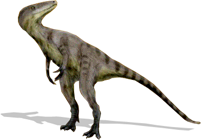
Xiongguanlong is similarly slender, fuzzy and long-armed but somewhat bigger than the oldest (smallest) tyrannosauroids, but somewhat smaller than the large-skulled, robust-jawed and short-armed latest (largest) tyrannosauroids, though it does mark the earliest appearance of some of the latter's hallmarks. A short, broad braincase, broad bony struts at the temples and expanded areas for jaw muscle attachment all represent modifications for increased bite force, combined with a midline crest at the back of the skull and expanded structures on the neck vertebrae to support a large head. Funnily enough, Xinguanlong had a large head thanks mainly to a stupendously slender, long, smooth snout that accounted for two-thirds of its skull's length. And its teeth were blade-like rather than conical, so tyrannosauroids weren't crunching bones just yet.
Xiongguanlong is similarly slender, fuzzy and long-armed but somewhat bigger than the oldest (smallest) tyrannosauroids, but somewhat smaller than the large-skulled, robust-jawed and short-armed latest (largest) tyrannosauroids, though it does mark the earliest appearance of some of the latter's hallmarks. A short, broad braincase, broad bony struts at the temples and expanded areas for jaw muscle attachment all represent modifications for increased bite force, combined with a midline crest at the back of the skull and expanded structures on the neck vertebrae to support a large head. Funnily enough, Xinguanlong had a large head thanks mainly to a stupendously slender, long, smooth snout that accounted for two-thirds of its skull's length. And its teeth were blade-like rather than conical, so tyrannosauroids weren't crunching bones just yet.
(Dragon of the Grand Pass)Etymology
Xiongguanlong is derived from the Mandarin "Xiong Guan" (Grand Pass), an old name for the nearby city of Jiayuguan (the western start point of the 8,850-km-long Ming Dynasty "Great Wall of China"), and "long" (dragon). The species epithet, baimoensis (by-mo-EN-sis), is derived from "bai mo" (White ghost), referring to a prominent feature in the area known as "White Ghost Castle", and the Latin "-ensis" (from).
Discovery
The remains of Xiongguanlong were discovered in the White Ghost Castle field area, Xinminbao Group, Yujingzi Basin, Gansu, China in 2005.
The holotype (FRDC-GS JB16-2-1) consists of a complete skull minus the lower jaw, some vertebrae, a partial hip bone (ilium) and a right thigh bone (femur).


