




Pronunciation: PEE-at-NYITS-key-SOR-us
Meaning: Piatnitzky's lizard
Author/s: Bonaparte (1979)
Synonyms: None known
First Discovery: Chubut, Argentina
Acta Ordinal: #275
Piatnitzkysaurus floresi
The Middle Jurassic is an important time for our understanding of the evolution of theropod dinosaurs, not least because it ushered in Tetanurae; arguably the most diverse group of this clade, and the one that gave rise to modern birds. It's a bit unfortunate, then, that Middle Jurassic theropod dinosaurs are so poorly known. And this was especially true of the Southern Hemisphere which, until the discovery of Piatnitzkysaurus, had yielded just a tiny handful of these most elusive critters, and none of them included so much as a scrap of skull material.
Named in honor of Alejandro Piatnitzky who discovered the area in Chubut Province where its remains were found, Piatnitzkysaurus represents one of the few well-represented theropods from the Middle Jurassic, one of the only diagnosable theropods from the Jurassic of South America, and one of most completely known primitive tetanurines to boot. In short, it was something of a boon, primed to add a few sentences to a little understood chapter of dinosaur diversification.
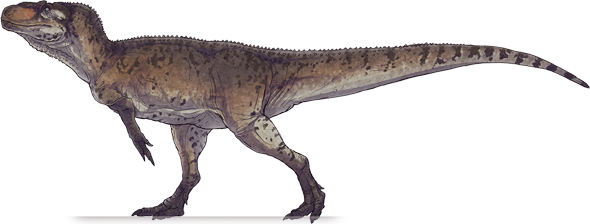
It's body fossils suggest they belong to a lightly built carnivore around 4.5 meters in length with robust arms and a no-nonsense skull, though the holotype was not fully grown, and its braincase shares several features with that of the enigmatic French Middle Jurassic theropod Piveteausaurus. However, it seems most closely related to Condorraptor from the same period, the same country, and pretty much the same locality, and many experts suspect that's because their fossils belong to the same dinosaur, despite slight differences in the hip vertebrae.
Piatnitzkysaurus was initially identified as an Allosaurus-like allosaurid by Jose Bonaparte in 1979, but has since been reassigned to Megalosauroidea. In 2012, Carrano et al chose it to anchor Piatznikysauridae, a megalosauroid family which also includes Marshosaurus bicentesimus and Condorraptor, suggesting the latter may be distinct afterall.
Named in honor of Alejandro Piatnitzky who discovered the area in Chubut Province where its remains were found, Piatnitzkysaurus represents one of the few well-represented theropods from the Middle Jurassic, one of the only diagnosable theropods from the Jurassic of South America, and one of most completely known primitive tetanurines to boot. In short, it was something of a boon, primed to add a few sentences to a little understood chapter of dinosaur diversification.
It's body fossils suggest they belong to a lightly built carnivore around 4.5 meters in length with robust arms and a no-nonsense skull, though the holotype was not fully grown, and its braincase shares several features with that of the enigmatic French Middle Jurassic theropod Piveteausaurus. However, it seems most closely related to Condorraptor from the same period, the same country, and pretty much the same locality, and many experts suspect that's because their fossils belong to the same dinosaur, despite slight differences in the hip vertebrae.
Piatnitzkysaurus was initially identified as an Allosaurus-like allosaurid by Jose Bonaparte in 1979, but has since been reassigned to Megalosauroidea. In 2012, Carrano et al chose it to anchor Piatznikysauridae, a megalosauroid family which also includes Marshosaurus bicentesimus and Condorraptor, suggesting the latter may be distinct afterall.
(Flores and Piatnitzky's lizard)Etymology
Piatnitzkysaurus is derived from "Piatnitzky" (for Alejandro Mateievich Piatnitzky [1879-1959], a Russian-born Argentine geologist who discovered the Jurassic Cerro Condor fossil locality) and the Greek "sauros" (lizard). The species epithet, floresi, honors a second geologist; Miguel Alejandro Flores.
Discovery
 The first fossils of Piatnitzkysaurus were discovered in the Canadon Asfalto Formation (Sierre de Olte Group) at Cerro Cóndor Village, Chubut Province, Argentina. The locality was discovered in 1936 but wasn't actually worked until 1977.
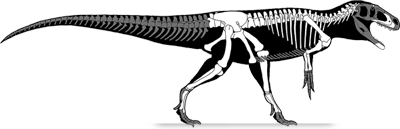
 The holotype (PVL 4073) is the almost complete skeleton of a 4.3m sub-adult specimen, with an ischium length of 423 mm. A second specimen (MACN-CH 895, a partial skull and skeleton) was found in the same quarry as the first, along with bones belonging to the sauropods Volkheimeria and Patagosaurus.


