




Pronunciation: BIE-ruh-no-SOR-us
Meaning: Byron Jaffe's lizard
Author/s: Norell, Makovicky and Clark (2000)
Synonyms: None known
First Discovery: Omnogovi, Mongolia
Acta Ordinal: #471
Byronosaurus jaffei
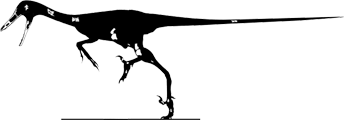
Informally tagged Byranjaffia in Novacek's "Time Traveler: In search of dinosaurs and ancient mammals from Montana to Mongolia", Byronosaurus is a member of Troodontidae; the smallish, carnivorous, "bird-like" critters with long legs, large retractable claws on their second toes and unusually large brains, at least among dinosaurs. Most of them have serrated teeth, but Byronosaurus, like Xixiasaurus, Mei, Anchiornis, and Urbacodon, doesn't. Its teeth are more needle-like, akin to those of Archaeopteryx aka Urvogel, which means "first bird". A chamber in its snout to ferry air to and from a flow-through breathing system is another feature it shares with birds.
As well as a couple of adult specimens, two hatchling Byronosaurus skulls have also been discovered in what palaeontologists believe to be a nest belonging to an unrelated oviraptorid, perhaps Citipati. Their presence has prompted plenty of head-scratching in scientific circles, but four equally plausible hypotheses have been proposed; they were either (1) prey of the adult Citipati, (2) they were there to prey on hatchling Citipati, (3) an adult Byronosaurus had laid her eggs there to exploit the oviraptorid's superior brooding skills in an act known as "nest parasitism" or (4) they were washed there from a nearby Byronosaurus nest.
As well as a couple of adult specimens, two hatchling Byronosaurus skulls have also been discovered in what palaeontologists believe to be a nest belonging to an unrelated oviraptorid, perhaps Citipati. Their presence has prompted plenty of head-scratching in scientific circles, but four equally plausible hypotheses have been proposed; they were either (1) prey of the adult Citipati, (2) they were there to prey on hatchling Citipati, (3) an adult Byronosaurus had laid her eggs there to exploit the oviraptorid's superior brooding skills in an act known as "nest parasitism" or (4) they were washed there from a nearby Byronosaurus nest.
Etymology
Byronosaurus is derived from "Byron Jaffe" ("in recognition of his family's support for the Mongolian Academy of Sciences-American Museum of Natural History Paleontological Expeditions") and the Greek "sauros" (lizard). The species epithet (or specific name), jaffei (JAF-ee-ie), also honors B.J.
Discovery
The first remains of Byronosaurus were discovered in the Djadokhta Formation at Ukhaa Tolgod, Omnogov, Mongolia, by Michael Novacek, a member of an American Museum of Natural History expedition, in 1993.
The holotype (IGM 100/983) includes skeletal bones that were collected as surface float and one of the best preserved troodontid
skulls discovered thus far.
A second adult specimen (IGM 100/984) was found on July 15, 1996 at Bolor's Hill, about 8 kilometers away from the holotype site.


