




Pronunciation: teh-RAT-o-FO-nee-us
Meaning: Monstrous murderer
Author/s: Carr et al. (2011)
Synonyms: None known
First Discovery: Utah, USA
Acta Ordinal: #777
Teratophoneus curriei
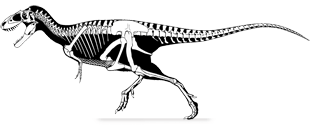
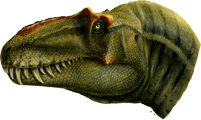
Hot on the heels of Bistahieversor from New Mexico, Teratophoneus became only the second tyrannosaur known from southwestern North America when Thomas Carr eventually coined the name in 2011. It differs from its closest relatives, Daspletosaurus and Tyrannosaurus, in having a shorter snout with fewer teeth and was the most basal tyrannosaurine known from North America until the discovery of Utah's Lythronax in 2013.
Teratophoneus, plus the likes of Talos, Utahceratops, Kosmoceratops and other weirdies, occupied the southern part of Laramidia: an island that was separated from Appalachia to the east by the Western Interior Seaway for a chunk of the Late Cretaceous, but which together form the current continent of North America. All of those southern critters differ wildly from their northern relatives, which led some palaeontologists to speculate that the islands' dinosaur population became further segregated when a natural barrier, perhaps an unpassable flood plain caused by rising sea levels, appeared around 77 mya, prompting species each side of it to evolve their distinct quirks. That hypothetical impasse disappeared some 1.2 million years later, based on the discovery of similar species in rocks of both northern and southern Laramidia dated just after this time, but, unfortunately, it left no trace of its true identity, if it even existed at all.
Teratophoneus, plus the likes of Talos, Utahceratops, Kosmoceratops and other weirdies, occupied the southern part of Laramidia: an island that was separated from Appalachia to the east by the Western Interior Seaway for a chunk of the Late Cretaceous, but which together form the current continent of North America. All of those southern critters differ wildly from their northern relatives, which led some palaeontologists to speculate that the islands' dinosaur population became further segregated when a natural barrier, perhaps an unpassable flood plain caused by rising sea levels, appeared around 77 mya, prompting species each side of it to evolve their distinct quirks. That hypothetical impasse disappeared some 1.2 million years later, based on the discovery of similar species in rocks of both northern and southern Laramidia dated just after this time, but, unfortunately, it left no trace of its true identity, if it even existed at all.
Etymology
Teratophoneus (suggested by S. Modesto) is derived from the Greek "teras" (monster) and "phoneus" (murderer) which may give the impression of a terrifying giant. However, at an estimated ton, the holotype was only one eigth the mass of Tyrannosaurus rex, though it's most probably a juvenile. The species epithet, curriei, honours Canadian palaeontologist Philip J. Currie.
Discovery
 The first remains of Teratophoneus were discovered at "RAM V201017" in the middle unit of the Kaiparowits Formation, Grand Staircase-Escalante National Monument, Utah, USA, by Brigham Young University (BYU) masters student Sam Webb in 1981.
 The holotype (BYU 8120, including specimens previously catalogued as BYU 8120/9396, BYU 8120/937, BYU 826/9720, BYU 9398 and BYU 13719) is an incomplete skull and skeleton. A nearly complete second specimen (UMNH VP 16690) was discovered by Jelle Wiersma and described by Loewen et al. in 2013.
In July 2014, Alan Titus found the first remains of what would turn out to be a Teratophoneus bonebed while searching for fossilised turtles in southern Utah. The site, now known as "Rainbows and Unicorns Quarry" (14UTKA-8) because of its unusual concentration of large bones and high diversity, contained four or possibly five animals, ranging from 4-22 years of age, that were victims of a mass mortality event, most likely a flash flood. The fact that numerous multi-age specimens died together suggests Tyrannosaurids, such as Teratophoneus, Albertosaurus and Daspletosaurus, which are all known from mass bonebeds, lived in groups rather than being solitary hunters, as they're often portrayed.


