




Pronunciation: jen-HWAHN-long
Meaning: Zhenyuan's dragon
Author/s: Lü and Brusatte (2015)
Synonyms: None known
First Discovery: Liaoning Province, China
Acta Ordinal: #915
Zhenyuanlong suni
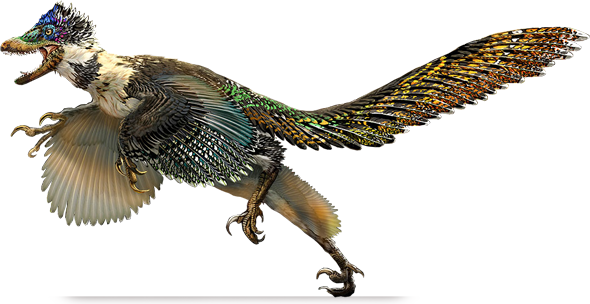
Zhenyuanlong suni is the largest non-bird dinosaur that has ever been found with full-blown, bird-like wings. Although bigger feathered dinosaurs have been discovered, none have possessed such complex layers of quill pen-like feathers made up of fibrous branches stemming from a central shaft. However, they were attached to tiny arms that were hopeless for flight and may instead have been used for ostentatious displays to attract a mate, egg incubation, plain old warmth, or all three.
(Zhenyuan's dragon)Etymology
Zhenyuanlong is derived from "Zhenyuan" (for Zhenyuan Sun, a representative of the Jinzhou Paleontological museum who procured the specimen from a Liaoning farmer.
and the Chinese "long" (dragon). The species epithet, suni, also honours Zhenyuan Sun.
Discovery
The remains of Zhenyuanlong were discovered in the Yixian formation, near Sihedang Town in Jianchang County, Liaoning Province, China, by a local farmer who is not willing to reveal his identity. The holotype (JPM-0008—housed at the Jinzhou Paleontological museum) is a nearly complete skeleton with skull and lower jaw, preserved on a slab of fissile siltstone. The slab is comprised of three large pieces: the first includes the head, shoulder girdles, arms, neck, and front part of the back and ribcage; the second includes the rear part of the back and ribcage, the pelvic girdles and legs; and the third includes the front-to-middle portion of the tail.
Preparator
Y.Q. Zhang of the Institute of Geology, Chinese Academy of Geological Sciences (CAGS).


