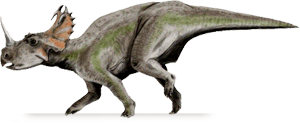
CENTROSAURUS
a plant-eating centrosaurine ceratopsid dinosaur from the Late Cretaceous of Canada.
Pronunciation: SEN-tro-SOR-us
Meaning: Sharp Pointed Lizard
Author/s: Lambe (
1904)
Synonyms: See
below
First Discovery: Alberta, Canada
Acta Ordinal: #91
Centrosaurus apertus
(Open Pointed lizard)Etymology
Centrosaurus is derived from the Greek "kentron" (point or prickle) and "sauros" (lizard). This isn't a reference to its huge nose horn (an unknown feature when it was named) but to the two hook shaped prongs on the apex of its frill. The
species epithet,
apertus, means "open, without covering, uncovered" in Latin, referring to the large paired openings (parietal fenestrae) in the frill.
Due to a misunderstanding of the rules of nomenclature, a panic stricken Hennig added an extra "ur" to his later-named stegosaurid
Kentrosaurus (Kentr
urosaurus) in 1916 and Franz Nopcsa almost simultaneously renamed it
Doryphorosaurus. Although derived from the same Greek words as
Centrosaurus,
Kentrosaurus begins with a "k" which is enough to separate the two, so the panic was all for nought.
In 1989 Chure and McIntosh unnecessarily coined
Eucentrosaurus as a replacement for
Centrosaurus, believing Fitzinger had assigned that name to a horned toad in 1843.
Discovery
The first fossil of
Centrosaurus was the
holotype skull (NMC 971) from Red Deer River in Alberta, Canada, which Lawrence Lambe originally assigned to
Monoclonius dawsoni in 1902. Although now known from many specimens of all age ranges (some with skin impressions) and vast Dinosaur Provincial Park bonebeds ("The Hilda Mega-Bonebed") where thousands of individuals died together, perhaps during a failed river crossing, not a single
Centrosaurus specimen has been discovered outside of Alberta.
Centrosaurus apertus is the only adult centrosaurine without spike-like ornaments midway up the skull.
Estimations
Timeline:
Era: Mesozoic
Epoch: Late Cretaceous
Stage: Campanian
Age range: 80-73 mya
Stats:
Est. max. length: 5.5 meters
Est. max. hip height: 2 meters
Est. max. weight: 2.3 tons
Diet: Herbivore
Monoclonius dawsoni (Lambe, 1902)
Brachyceratops dawsoni (Lambe, 1915)
Brachyceratops dawson (Lambe, 1915) = Lapsus calami
Centrosaurus dawsoni (Sternberg, 1940)
Monoclonius nasicornus (Brown, 1917)
Monoclonius (
Centrosaurus)
nasicornus (Lull, 1933)
Monoclonius cutleri (Brown, 1917)
Centrosaurus cutleri (Russell, 1930)
Monoclonius (
Centrosaurus)
cutleri (Lull, 1933)
Monoclonius flexus (Brown, 1914)
Monoclonius (
Centrosaurus)
flexus (Lull, 1933)
Monoclonius inflexus (Kuhn, 1936) = Lapsus calami?
Centrosaurus longirostris (Sternberg, 1940)
Monoclonius longirostris (Kuhn, 1964)
Monoclonius (
Centrosaurus)
apertus (Lull, 1933)
Monoclonius apertus (Kuhn, 1964)
Eucentrosaurus apertus (Chure and McIntosh, 1989)
References
• Lambe LM (1902) "New genera and species from the Belly River Series (mid-Cretaceous)".
Geological Survey of Canada, Contributions to Canadian Palaeontology, 3(2): 25-81. [Monoclonius dawsoni.]
• Lambe LM (1904) "
On the squamoso-parietal crest of the horned dinosaurs Centrosaurus apertus and Monoclonius canadensis from the Cretaceous of Alberta".
Proceedings and Transactions of the Royal Society of Canada, Series 2, 10(4): 1-9.
• Brown B (1914) "A complete skull of
Monoclonius, from the Belly River Cretaceous of Alberta".
Bulletin of the AMNH, 33(34): 549-558. [Monoclonius flexus.]
• Lambe LM (1915) "Report of the vertebrate palaeontologist".
Summary report of the Geological Survey Department of Mines for the Calendar Year 1914, 1503: 116-121.
• Brown B (1917) "A complete skeleton of the horned dinosaur Monoclonius, and description of a second skeleton showing skin impressions".
Bulletin of the American Museum of Natural History, 37(10):281-306. [Monoclonius cutleri.]
•
Lull RS (1933) "
A revision of the Ceratopsia or horned dinosaurs".
• Kuhn O (1964) "Ornithischia: Fossilium Catalogus I, Animalia".
Pars 105: 1-80. [Monoclonius longirostris.] [Monoclonius inflexus.]
• Sternberg CM (1940) "Ceratopsidae from Alberta".
Journal of Paleontology, 14(5): 468–480. [Centrosaurus longirostris.]
• Dodson P (1990) "On the status of the ceratopsids
Monoclonius and
Centrosaurus". Page 231-243 in "
Dinosaur Systematics: Perspectives and Approaches".
• Rogers RR (1990) "Taphonomy of three dinosaur bone beds in the Upper Cretaceous Two Medicine Formation, northwestern Montana: Evidence for drought-related mortality".
PALAIOS, 5(5): 394–41. DOI: 10.2307/3514834.
• Dodson P and Britt B, Carpenter K and Forster CA, Gillette DD and Norell MA, Olshevsky G and Parrish MJ, Weishampel DB (1994) "Centrosaurus". Page 135 in "
The Age of Dinosaurs".
• Dodson P (1996) "
The Horned Dinosaurs: a Natural History".
• Dodson P, Forster CA and Sampson SD (2004) "Ceratopsidae". Page 494-513 in Weishampel, Dodson and Osmólska (eds.) "
The Dinosauria: Second Edition".
• Ryan MJ and Russell AP (2005) "
A new centrosaurine ceratopsid from the Oldman Formation of Alberta and its implications for centrosaurine taxonomy and systematics".
 Canadian Journal of Earth Sciences. 42(7): 1369-1387. DOI: 10.1139/e05-029.
• Ryan MJ and Evans DC (2005) "Ornithischian Dinosaurs". Page 312-348 in Currie and Koppelhus (eds.) "
Dinosaur Provincial Park: A Spectacular Ancient Ecosystem Revealed".
• Eberth DA and Getty MA (2005) "Ceratopsian bonebeds: occurrence, origins, and significance". Page 501-536 in Currie and Koppelhus (eds.) "
Dinosaur Provincial Park: A Spectacular Ancient Ecosystem Revealed".
• Paul GS (2010) "
The Princeton Field Guide to Dinosaurs".
• Frederickson JA and Tumarkin-Deratzian AR (2014) "Craniofacial ontogeny in
Centrosaurus apertus".
PeerJ, 2: e252. DOI: 10.7717/peerj.252.
• Ekhtiari S, Chiba K, Popovic S, Crowther R, Wohl G, Wong AKO, Tanke DH, Dufault DM, Geen OD, Parasu N, Crowther MA and Evans DC (2020) "First case of osteosarcoma in a dinosaur: a multimodal diagnosis".
The Lancet Oncology, 21(8): 1021-1022. DOI: 10.1016/S1470-2045(20)30171-6.
Time stands still for no man, and research is ongoing. If you spot an error, or want to expand, edit or add a dinosaur, please use
this form. Go
here to contribute to our FAQ.
All dinos are GM free, and no herbivores were eaten during site construction!
To cite this page:
Atkinson, L.
"
CENTROSAURUS :: from DinoChecker's dinosaur archive".
‹
http://www.dinochecker.com/dinosaurs/CENTROSAURUS›. Web access: 09th Sep 2026.