




Pronunciation: ZEE-no-SEH-ruh-tops
Meaning: Strange horn face
Author/s: Ryan et al. (2012)
Synonyms: None known
First Discovery: Alberta, Canada
Acta Ordinal: #833
Xenoceratops foremostensis
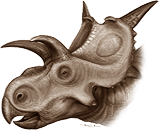
At around 0.5 million years older than Albertaceratops from the lower Oldman Formation of Alberta, Xenoceratops is the oldest known Canadian ceratopsian. It's the basalmost centrosaurine to, but it took 78 million years to describe and in the meantime a UK television show stole in and used the name first. Or so we were led to believe by the Spanish version of a certain 'pedia beginning with "W".
As entertaining as it is "Primeval" isn't classed as an official scientific platform, so strictly speaking their Xenoceratops, who wandered through an anomaly and came second best in a collision with a car, carries no scientific value. The funny thing is, we're big fans of Primeval, we've watched every episode and read every book, and there ain't no Xenoceratops in it! Anyway, the beast was unleashed in 2012, but exuberance had gotten the better of someone somewhere.
The powers that be embargoed Xenoceratops until November 8th, but it was accidentally published online a month too soon, and eagle-eyed bloggers clocked it despite its swift removal from the offending website. The now official release is the vehicle in which Michael J. Ryan also coined Coronosaurus for the fossils that were previously named Centrosaurus brinkmani, and this was a bit surprising because Ryan coined Centrosaurus brinkmani himself in 2005.
As entertaining as it is "Primeval" isn't classed as an official scientific platform, so strictly speaking their Xenoceratops, who wandered through an anomaly and came second best in a collision with a car, carries no scientific value. The funny thing is, we're big fans of Primeval, we've watched every episode and read every book, and there ain't no Xenoceratops in it! Anyway, the beast was unleashed in 2012, but exuberance had gotten the better of someone somewhere.
The powers that be embargoed Xenoceratops until November 8th, but it was accidentally published online a month too soon, and eagle-eyed bloggers clocked it despite its swift removal from the offending website. The now official release is the vehicle in which Michael J. Ryan also coined Coronosaurus for the fossils that were previously named Centrosaurus brinkmani, and this was a bit surprising because Ryan coined Centrosaurus brinkmani himself in 2005.
(Strange Horn Face from Foremost Village)Etymology
Xenoceratops is derived from the Greek "xenos" (strange, foreign, alien), "ceras" (horn) and "-ops" (face), referring to the rarity of ceratopsian material in the Foremost Formation.
The species epithet, foremostensis, means "from Foremost" in Latin, and refers to its discovery near the village of Foremost in Alberta.
Discovery
 The first remains of Xenoceratops were discovered in the Foremost Formation (Belly River Group) at Chin Coulee, 7 km northeast of the Village of Foremost, Alberta, Canada, by Dr. Wann Langston Jr. way back in 1958, but spent half a century filed away at Ottawa's Canadian Museum of Nature until they were discovered for a second time. The holotype (CMN 53282) was initially a composite of three skull frill pieces fudged together. The most complete piece now carries the holotype code (CMN 53282), while the other two (CMN 54950 and CMN 54951) are paratypes.
Twelve referred specimens (none of which can be confidently referred to the holotype or paratypes, but likely pertain to these specimens owing to their close association), all amount to skull or frill fragments, and were assigned sequential specimen numbers from CMN 54952 to CMN 54964. CMN 54965 was assigned to several unidentified fragments.


