




Pronunciation: JYAH-LING-o-SOR-us
Meaning: Jialing (River) lizard
Author/s: Young (1959)
Synonyms: None known
First Discovery: Sichuan, China
Acta Ordinal: #211
Chialingosaurus kuani
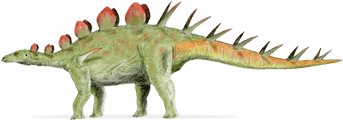
Bearing an uncanny resemblance to Tendaguru's Kentrosaurus, which was the inspiration for Young's 1959 reconstruction, Chialingosaurus was the first member of Stegosauridae—the plated branch of the armoured dinosaurs known collectively as thyreophorans—ever found in China. It is also one of the oldest stegosaurids known from anywhere and was once touted as a possible ancestor of them all. But the discovery of Huayangosaurus, which was a good three million years older, put the kibosh on that theory.
As far as stegosaurids go, Chialingosaurus is small and delicate (though that might be due to all specimens being either juvenile or sub-adult) with a long and narrow wedge-shaped skull, rather long and slender forelimbs, and small paired plates on its neck, back and tail. In fact, the only robust part of it, based on current evidence, is a thick lower jaw that sports just a few small, well-spaced teeth with almost completely destroyed crowns and no sign of replacements. The latter may be a species-specific feature as it's unlikely that the not-yet fully grown individual with the only known jaw could have used its full complement of teeth through natural wear and tear if replacements were available. Or perhaps it suffered from a nasty case of Jurassic periodontitis, and the teeth that were present were the only ones that hadn't yet fallen from its rotting gums.
As far as stegosaurids go, Chialingosaurus is small and delicate (though that might be due to all specimens being either juvenile or sub-adult) with a long and narrow wedge-shaped skull, rather long and slender forelimbs, and small paired plates on its neck, back and tail. In fact, the only robust part of it, based on current evidence, is a thick lower jaw that sports just a few small, well-spaced teeth with almost completely destroyed crowns and no sign of replacements. The latter may be a species-specific feature as it's unlikely that the not-yet fully grown individual with the only known jaw could have used its full complement of teeth through natural wear and tear if replacements were available. Or perhaps it suffered from a nasty case of Jurassic periodontitis, and the teeth that were present were the only ones that hadn't yet fallen from its rotting gums.
(Kuan Yao Wu's Chialing lizard)Etymology
Chialingosaurus is derived from the Chinese "jia" (fine) and "ling" (hill) for Jialingjiang aka Chialingchiang (Fine Hill River), and the Greek "sauros" (lizard). The species epithet, kuani, is named in honour of Kuan Yao Wu who was surveying the middle reaches of the Chialing river in 1957 when he discovered this specimen.
Discovery
The first remains of Chialingosaurus were discovered at "Taipingzhai" in the village of Pinganxiang, Upper Shaximiao (Shangshaximiao) Formation, Chongqing (Chunking) Group, Quxian County, China, by Kuan Yao Wu (aka Yaowu Guan) of the Sichuan Regional Petroleum Exploration Office in 1957.
The holotype (IVPP V2300) includes six fragmentary vertebrae, some limb material, three dorsal spines, a left shoulder blade and three toes. Re-excavation of the area, after numerous fossils were reported by Angui Wang of the Quxian
County Hydroelectric Office in November of 1978, resulted in the discovery of further remains, including a partial skull, three fragmentary neck vertebrae, four back vertebrae (two of which are relatively
complete), four tail vertebrae (one of which is complete), right shoulder blade, an ulna and radius (forearm bones), shin, calf, an ankle and heel, catalogued as CV00202. A third specimen (CV00203) consisting of two fragmentary neck vertebrae, six incomplete back vertebrae, five tail vertebrae lacking their spines, a piece of left ilium (a hipbone) and left thigh, discovered 100 meters from the main site, was made the paratype. All specimens are either juvenile or subadult.


