





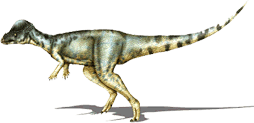
Pronunciation: a-LASS-kuh-SEF-uh-lee
Meaning: Alaska head
Author/s: Sullivan (2005)
Synonyms: None known
First Discovery: Alaska, USA
Acta Ordinal: #586
Alaskacephale gangloffi
Alaskacephale is a member of Pachycephalosauridae—the bipedal, herbivorous, thick-skulled critters affectionately known as "headbangers"—and is the only one of its kind known from Alaska. Heck, it's one of the few dinosaurs of any kind known from Alaska.
The problem is: it's known only from a domed skull cap attached to a piece of temple bone, so accurate size estimates are impossible. However, performing a like-for-like downscale based on the corresponding bit of Pachycephalosaurus—assuming, of course, that they were proportionately similar—gives Alaskacephale an estimated length of less than two meters and a weight of roughly a dozen kilos.
(Gangloff's Alaska head)
Etymology
 Alaskacephale is derived from "Alaska" (the state where the holotype was discovered), and the Latin "cephale" (head)—a common suffix attached to members of Pachycephalosauridae.
The species epithet, gangloffi,
honours paleontologist Roland Gangloff who found the remains, described them as an unnamed pachycephalosaurid (but possibly Pachycephalosaurus) in 2005, and who has contributed significantly to our understanding of dinosaurs of the North American Arctic region.
Alaskacephale is derived from "Alaska" (the state where the holotype was discovered), and the Latin "cephale" (head)—a common suffix attached to members of Pachycephalosauridae.
The species epithet, gangloffi,
honours paleontologist Roland Gangloff who found the remains, described them as an unnamed pachycephalosaurid (but possibly Pachycephalosaurus) in 2005, and who has contributed significantly to our understanding of dinosaurs of the North American Arctic region.
Discovery
The remains of Alaskacephale were discovered in the Prince Creek Formation (Colville Group) on the west bank of the Colville River, near the village of Nuiqsut in North Slope Borough, Alaska, USA, during an expedition by the University of Alaska in 1999.
The holotype (UAM AK-493-V-001—housed in the Earth Science Collections of the University of Alaska Museum at Fairbanks) is a nearly complete left squamosal (a temple bone) attached to a partial skull dome. Two rows of bony, pointed nodes sit between the upper temple and base of the dome, suggesting its skull was crowned with some sadistic, spikey Roman wreath.


