





Pronunciation: AY-zhuh-SEH-ruh-tops
Meaning: Asian horned face
Author/s: Nessov et al. (1989)
Synonyms: See below
First Discovery: Navoi, Uzbekistan
Acta Ordinal: #347
Asiaceratops salsopaludalis
Asiaceratops salsopaludalis is a small, early neoceratopsian from the Cenomanian-age Khodzhakul Formation of western Uzbekistan, known from scattered remains collected across the Kyzyl-Kum Desert. The holotype—a partial upper jaw (CCMGE 9/12457) with a few teeth—was recovered at Site SH-25 in the Khodzhakulsai locality, part of the Khodzhakul exposures that straddle the administrative boundary between Karakalpakstan and the Navoi Region. In their 1989 description, Nesov, Kaznyshkina, and Cherepanov assigned Asiaceratops the weighty task of anchoring its own subfamily—Asiaceratopsinae—within Protoceratopsidae, a taxonomic placement intended to stabilize the early branching structure of horned dinosaurs in Central Asia.
Alas, despite being bolstered by a plethora of remains from Khodzhakulsai, Sheikhdzheili, Chelpyk, and the Dzharakuduk/Itemir area which should have formed one of the most geographically detailed early ceratopsian records in the world, Asiaceratops turned out to be a bit of a let-down: most of its fossils are barely diagnostic, offering only a faded silhouette of an early ceratopsian rather than a sharply defined anatomical profile, and it can barely support itself, never mind an entire clade.
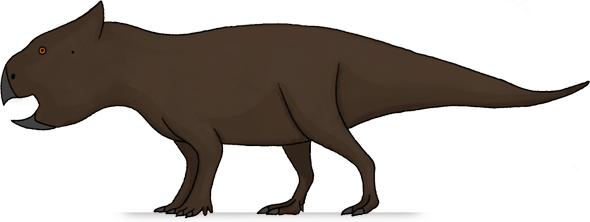
Anatomically, Asiaceratops represents a stage when ceratopsians—the dinosaurs colloquially known as "horned faces"—were all small, lightly built herbivores roughly one to two meters long, with a parrot-like beak, simple shearing teeth, only the faintest whiff of a neck frill, and, crucially, no horns on their faces. One specimen, an isolated skull base (TsNIGRI 496/12457), shows a triangular peg on the back part of the braincase that neatly slots into a triangular hole on the bone infront, forming a neatly interlocking articulation that may be a game-saving characteristic, although the referral of that fossil to Asiaceratops is only tentative, so its validity seems to hang precariously from a feature that it might not even own.
Whether Asiaceratops turns out to be a bona fide ceratopsian worthy of its own name or a juvenile specimen of a different critter entirely, it lived in a warm, semi-arid landscape of salt-marsh flats, ephemeral channels, and desert margins, sharing its environment with ankylosaurs, ornithomimids, small theropods, pterosaurs, and mammals such as Oxlestes. Its presence helps chart the early radiation of ceratopsians across Asia, showing that by the Cenomanian these small horned-but-hornless dinosaurs were already established across scattered oases of the Kyzyl-Kum—even if they had not yet diversified into the distinct lineages that would flourish later in the Cretaceous.
Alas, despite being bolstered by a plethora of remains from Khodzhakulsai, Sheikhdzheili, Chelpyk, and the Dzharakuduk/Itemir area which should have formed one of the most geographically detailed early ceratopsian records in the world, Asiaceratops turned out to be a bit of a let-down: most of its fossils are barely diagnostic, offering only a faded silhouette of an early ceratopsian rather than a sharply defined anatomical profile, and it can barely support itself, never mind an entire clade.
Anatomically, Asiaceratops represents a stage when ceratopsians—the dinosaurs colloquially known as "horned faces"—were all small, lightly built herbivores roughly one to two meters long, with a parrot-like beak, simple shearing teeth, only the faintest whiff of a neck frill, and, crucially, no horns on their faces. One specimen, an isolated skull base (TsNIGRI 496/12457), shows a triangular peg on the back part of the braincase that neatly slots into a triangular hole on the bone infront, forming a neatly interlocking articulation that may be a game-saving characteristic, although the referral of that fossil to Asiaceratops is only tentative, so its validity seems to hang precariously from a feature that it might not even own.
Whether Asiaceratops turns out to be a bona fide ceratopsian worthy of its own name or a juvenile specimen of a different critter entirely, it lived in a warm, semi-arid landscape of salt-marsh flats, ephemeral channels, and desert margins, sharing its environment with ankylosaurs, ornithomimids, small theropods, pterosaurs, and mammals such as Oxlestes. Its presence helps chart the early radiation of ceratopsians across Asia, showing that by the Cenomanian these small horned-but-hornless dinosaurs were already established across scattered oases of the Kyzyl-Kum—even if they had not yet diversified into the distinct lineages that would flourish later in the Cretaceous.
(Asian Horned Face of the Salt Marsh)Etymology
Asiaceratops combines a reference to Asia with the Greek "keras" (horn) and "ops" (face). The species epithet, salsopaludalis, means "of the salt marsh" in Latin.
Discovery
The first remains of Asiaceratops were discovered by Lev Alexandrovich Nessov during his 1974–75 field seasons at Site SH-25 in the Khodzhakulsai locality of the Khodzhakul Formation, Kyzyl-Kum Desert, in the Navoi region of Uzbekistan. The holotype (CCMGE 9/12457) is a partial left maxilla (a tooth-bearing bone of the upper jaw) with only four teeth. Over the following decades, a huge number of isolated fossils from Khodzhakulsai (SH-0, SH-5, SH-25), Sheikhdzheili (SSHD-8, SSHD-8a), Chelpyk (SCH-1, SCH-B), and the Dzharakuduk area's Itemir locality (IT-01) within the Khodzhakul Formation were referred to Asiaceratops salsopaludalis, including teeth and a toe bone (Nessov, 1989), and fragmentary skull bones, parts of two braincases, and copious vertebrae, girdle and limb bones (Nessov, 1995), all within a single size range and most likely belonging to juveniles. Almost all of this material (including the holotype) is considered non-diognostic. However, a skull base (TsNIGRI 496/12457), that was tentatively referred here, might actually sport a single unique feature: the back part of the braincase has a little triangular peg, the bone in front of it has a matching triangular hole, and the two parts slot neatly together like pieces of a jigsaw on the underside of the skull.


