



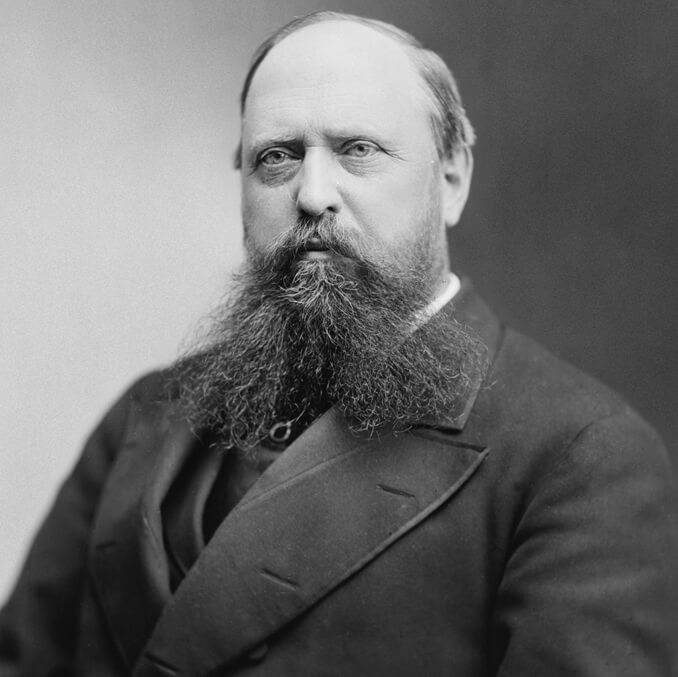
Date of Birth: October 29, 1831
Place of birth: Lockport, New York, USA
Parents: Caleb Marsh and Mary Gaines Peabody
Spouse: Never married
Date of expiry: March 18, 1899 (aged 67)
Place of expiry: New Haven, Connecticut, USA
Legacy: Yale's core fossil collection, Brontosaurus, Stegosaurus, Diplodocus, Triceratops, and more iconic dinosaurs
Othniel Charles Marsh
Othniel Charles Marsh was born on 29 October 1831 near Lockport, New York, the son of Caleb Marsh and Mary Gaines Peabody. His early years were marked by financial instability and a contentious relationship with his father, who expected him to work the family farm — a prospect Marsh detested. He preferred wandering the woods and canal cuts in search of fossils, often guided by Ezekiel Jewett, an amateur naturalist who recognized the boy’s talent. Marsh’s fortunes changed when his wealthy uncle, George Peabody, funded his education, sending him to Phillips Academy, Yale, and then to Europe for advanced study in Berlin, Heidelberg, and Breslau. In 1866 he returned to Yale as the first American professor of vertebrate paleontology, a position he would hold for the rest of his life. He never married and had no children, devoting himself entirely to research, teaching, and the expansion of Yale’s fossil collections.
Marsh’s career unfolded during a period of explosive scientific opportunity in the American West. Although he preferred directing fieldwork from New Haven — a habit that earned him a reputation as an "armchair paleontologist" — he nonetheless personally led four field seasons between 1870 and 1873, taking Yale students into the fossil-rich badlands of Wyoming, Colorado, and Kansas. Over the next three decades he sponsored expedition after expedition, amassing a vast collection of Mesozoic reptiles, Cretaceous birds, and Tertiary mammals. His teams discovered or described many of the dinosaurs that would become icons of the field: Apatosaurus, Brontosaurus, Stegosaurus, Diplodocus, Triceratops, and more. By the end of his life he had discovered or described over a thousand fossil vertebrates, publishing major works on toothed birds, fossil horses, and the succession of vertebrate life in America.
But Marsh’s name is forever entangled with the Bone Wars, his ferocious rivalry with Edward Drinker Cope. What began as professional competition escalated into espionage, bribery, accusations of fossil theft, and the destruction of quarries to deny specimens to the other side. Marsh’s tactics could be ruthless: he poached workers, pressured landowners, and used his influence in the U.S. Geological Survey — where he oversaw vertebrate paleontology beginning in 1882 — to sideline Cope. Yet he also produced meticulous descriptions and mounted a vigorous defense of Darwinian evolution at a time when American science was still divided.
Marsh's dominance, however, carried the seeds of his undoing. His appointment to oversee vertebrate paleontology for the U.S. Geological Survey gave him federal funding and national authority, but his aggressive tactics — hoarding specimens, claiming government fossils as personal property, and wielding his office against rivals — eventually drew scrutiny. Cope retaliated by publicly accusing Marsh of financial impropriety and abuse of power, triggering a congressional investigation. The inquiry exposed administrative irregularities within Marsh’s division, and the USGS responded by eliminating his department entirely, stripping him of salary, influence, and the institutional empire he had built. It was the greatest professional blow of his career, a collapse brought on as much by his own combative nature as by the rivalry that had defined it.
Marsh spent his final years at Yale, surrounded by the immense fossil collections he had built — the backbone of the Peabody Museum and a cornerstone of the Smithsonian’s holdings. He died of pneumonia on 18 March 1899 in New Haven, closing a life both brilliant and bruised. Beneath the rivalry and the politics was a scholar of formidable intellect and relentless ambition, a man who believed deeply in the power of bones to illuminate the history of life, and whose empire of fossils still anchors the great dinosaur halls of American museums.
Marsh’s career unfolded during a period of explosive scientific opportunity in the American West. Although he preferred directing fieldwork from New Haven — a habit that earned him a reputation as an "armchair paleontologist" — he nonetheless personally led four field seasons between 1870 and 1873, taking Yale students into the fossil-rich badlands of Wyoming, Colorado, and Kansas. Over the next three decades he sponsored expedition after expedition, amassing a vast collection of Mesozoic reptiles, Cretaceous birds, and Tertiary mammals. His teams discovered or described many of the dinosaurs that would become icons of the field: Apatosaurus, Brontosaurus, Stegosaurus, Diplodocus, Triceratops, and more. By the end of his life he had discovered or described over a thousand fossil vertebrates, publishing major works on toothed birds, fossil horses, and the succession of vertebrate life in America.
But Marsh’s name is forever entangled with the Bone Wars, his ferocious rivalry with Edward Drinker Cope. What began as professional competition escalated into espionage, bribery, accusations of fossil theft, and the destruction of quarries to deny specimens to the other side. Marsh’s tactics could be ruthless: he poached workers, pressured landowners, and used his influence in the U.S. Geological Survey — where he oversaw vertebrate paleontology beginning in 1882 — to sideline Cope. Yet he also produced meticulous descriptions and mounted a vigorous defense of Darwinian evolution at a time when American science was still divided.
Marsh's dominance, however, carried the seeds of his undoing. His appointment to oversee vertebrate paleontology for the U.S. Geological Survey gave him federal funding and national authority, but his aggressive tactics — hoarding specimens, claiming government fossils as personal property, and wielding his office against rivals — eventually drew scrutiny. Cope retaliated by publicly accusing Marsh of financial impropriety and abuse of power, triggering a congressional investigation. The inquiry exposed administrative irregularities within Marsh’s division, and the USGS responded by eliminating his department entirely, stripping him of salary, influence, and the institutional empire he had built. It was the greatest professional blow of his career, a collapse brought on as much by his own combative nature as by the rivalry that had defined it.
Marsh spent his final years at Yale, surrounded by the immense fossil collections he had built — the backbone of the Peabody Museum and a cornerstone of the Smithsonian’s holdings. He died of pneumonia on 18 March 1899 in New Haven, closing a life both brilliant and bruised. Beneath the rivalry and the politics was a scholar of formidable intellect and relentless ambition, a man who believed deeply in the power of bones to illuminate the history of life, and whose empire of fossils still anchors the great dinosaur halls of American museums.
More Marsh
• Marsh C and Cohen IB (Jun 1980) "The Life and Scientific Work of Othniel Charles Marsh (Three centuries of science in America)".
• New York Times (1899) "Professor Marsh is Dead. The World-Famous Geologist Succumbs to Pneumonia. Chair of Paleontology Founded for Him. Caused the Establishment of Peabody Museum".
• Schuchert C (1938) "Biographical memoir of Othniel Charles Marsh". National academy of sciences of the United States of America biograohical memoirs. Vol.XX-First memoir.

Discoveries and descriptions ...


