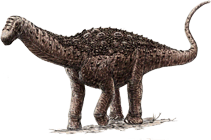
Pronunciation: yoo-SOH-ro-PO-duh
Author: Paul Upchurch
Year: 1995
Meaning: True sauropods (see etymology)
Locomotion: Quadrupedal (four legs)
Synonyms: None known
[Sereno, 2005]Definition
The most inclusive clade containing Saltasaurus loricatus but not Vulcanodon karibaensis.
About
Eusauropods first appear in the Early Jurassic, just after the Karoo–Ferrar volcanic event (184-180 Ma), a time of global environmental upheaval that reshaped terrestrial ecosystems. This episode of warming and climate disruption triggered major changes in plant communities worldwide, with southern Gondwana showing a particularly clear shift from diverse floras to conifers with small, scaly leaves. High-precision dating places the earliest eusauropods immediately after this transition, when new ecological conditions allowed them to expand from their basal ancestors and establish the lineage that would shape all later sauropod evolution.
Anatomically, eusauropods share a suite of key innovations related to their gigantic size, obligate quadrupedalism, and strictly herbivorous diets. Vertebral pneumaticity is widespread across the clade in varying degrees, with air-sac systems hollowing portions of the backbone to reduce weight while maintaining structural strength. Their necks tend to be longer and more flexible, their limbs and pelvic girdles strengthened to support increasing body mass, and their skulls restructured for bulk browsing: broad and robust U-shaped jaws to allow a wider and more powerful bite; the loss of fleshy cheeks to increase gape; the development of plates along the inner sides of the teeth that brace against the side-to-side forces generated during foliage stripping; and thick wrinkly tooth enamel. These changes collectively establish a more efficient and scalable bauplan that later sauropod groups would embrace and adjust—and in some cases, take to extremes.
By the Middle Jurassic (around 170 Ma), eusauropods were the only surviving sauropodomorph lineage. These early eusauropods diversified into several offshoots—mamenchisaurids, turiasaurs, and cetiosaurids—that flourished before gradually giving way to the more derived forms that would evolve into Neosauropoda. From this transition emerged the later radiations of diplodocoids and macronarians, which carried the eusauropod body plan into new ecological roles and ultimately became the dominant herbivores of Jurassic and Cretaceous ecosystems on all major continents, leaving behind a fossil record that charts the most dramatic evolutionary expansion in sauropod history.
Click here to search Dinochecker for eusauropods.
Etymology
Eusauropoda is derived from the Greek "eu" (good, true), "sauros" (lizard) and "pod" (foot).
Relationships
References
• Upchurch P (1995) "The evolutionary history of sauropod dinosaurs". Philos Trans R Soc Lond B Biol Sci, 349(1330): 365–390.
• Holtz TR Jr (2008) "The Most Complete, Up-to-Date Encyclopedia for Dinosaur Lovers of All Ages".
• Yates AM, Bonnan MF, Neveling J, Chinsamy A and Blackbeard MG (2010)
"A new transitional sauropodomorph dinosaur from the Early Jurassic of South Africa and the evolution of sauropod feeding and quadrupedalism". Proceedings of the Royal Society B, 277: 787-794. DOI: 10.1098/rspb.2009.1440.