


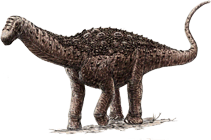
Pronunciation: mass-o-PO-duh
Author: Adam M. Yates
Year: 2007
Meaning: Lumpy feet
Locomotion: Bi and/or Quadrupedal (two and/or four legs)
Synonyms: None known
[Yates, 2007]Definition
All sauropodomorph dinosaurs more closely related to Saltasaurus loricatus than to Plateosaurus engelhardti.
About
Massopoda emerged in the Late Triassic and diversified markedly through the Early Jurassic and beyond, inheriting the plateosaurian blueprint and beginning the long anatomical drift toward a more consistently weight-tolerant body plan.
Across the group, several evolutionary trends recurred. Necks generally lengthened and lightened; forelimbs become more robust; and the torso often broadened to accommodate increasingly capacious digestive systems. Many primal massopodans remained competent bipeds, yet their hands—once precise grasping tools inherited from sauropodomorph predecessors—show early signs of reduced flexibility in certain branches, hinting at the eventual shift toward quadrupedal stability. Their skulls frequently deepen, their teeth become more uniform, and feeding mechanics tilt decisively toward bulk herbivory.
Early massopodans do not yet possess the towering frames of their descendants, but they assembled the architectural groundwork that carried sauropodomorphs across a critical evolutionary threshold. They bridged the gap between versatile, occasionally omnivorous early forms and the fully committed high-volume herbivores to come; between agile bipeds and creatures preparing for the immense, load-bearing stance of true giants. Without their incremental shifts in posture, feeding strategy, and body plan, the rise of true sauropods—and the iconic silhouettes that dominated the Mesozoic—would lack the evolutionary foundation on which they stand.
Click here to view Dinochecker's A-Z list of massopodans.
Etymology
Massopoda is derived from the Latin "massa" (lump) and the Greek "pous" (foot), referring to the clade's shift towards bulky, weight-bearing feet. It is also a contraction of Massospondylidae and Sauropoda, two major groups that it unites.
Relationships
References
• Yates AM (2007) "Solving a dinosaurian puzzle: the identity of Aliwalia rex Galton". Historical Biology, 19: 93-123.


