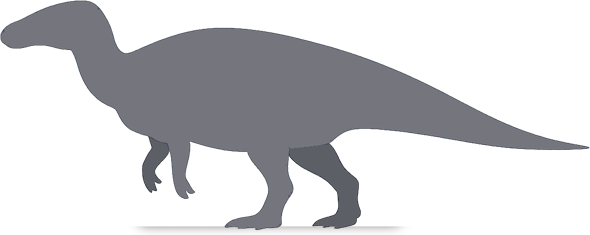
GONGSHUILONG
a saurolophine hadrosaurid dinosaur from the Late Cretaceous of China.
Pronunciation: GONG-shway-long
Meaning: Gong River dragon
Author/s: Yao
et al. (
2026)
Synonyms: None known
First Discovery: Jiangxi Province, China
Acta Ordinal: #1240
Gongshuilong fanwei
(Gong River dragon with a sail-like tail)Etymology
Gongshuilong is derived from the Mandarin Pinyin "Gongshui" (for the Gong river, close to the fossil site) and "long" (dragon).
The
species epithet,
fanwei, is also a Pinyin term, and means "sail tail".
ZooBank registry:
urn:lsid:zoobank.org:act:221FCD08-59F6-4637-9BC5-D50EB904EE2C.
Discovery
The remains of
Gongshuilong were discovered in the Lianhe Formation at Shahe town, Ganzhou City, Jiangxi Province, South China, by construction workers at the East China International Trade and Industrial Zone, in March 2021.
The
holotype (BGS-JX F001) is a right dentary (a tooth bearing bone of the lower jaw). A small portion of a skull (BGS-JX F001-2) represents a paratype.
Preparators
Lishi Xiang, Beijing Wubo Technology Co. Ltd. and Chongzhou Tianyan Museum.
Estimations
Timeline:
Era: Mesozoic
Epoch: Late Cretaceous
Stage: Maastrichtian
Age range: 72-66 mya
Stats:
Est. max. length: ?
Est. max. hip height: ?
Est. max. weight: ?
Diet: Herbivore
References
• Yao H, Qiu W, Yu J, Yang L, Wang H, Cao S, Zhao K, Xu M, Shi G, Lou F, Zeng C, Lu P, Wu R, Xu X, Han F and Xing H (2026) "A new saurolophine hadrosaurid (Dinosauria: Ornithopoda) from the Upper Cretaceous of South China, providing further support for the possible Asian origin of Brachylophosaurini".
Journal of Systematic Palaeontology, 24(1): 2635569. DOI: 10.1080/14772019.2026.2635569.
Time stands still for no man, and research is ongoing. If you spot an error, or want to expand, edit or add a dinosaur, please use
this form. Go
here to contribute to our FAQ.
All dinos are GM free, and no herbivores were eaten during site construction!
To cite this page:
Atkinson, L.
"
GONGSHUILONG :: from DinoChecker's dinosaur archive".
‹
http://www.dinochecker.com/dinosaurs/GONGSHUILONG›. Web access: 24th Oct 2026.