



Date of Birth: 18 February, 1839
Place of Birth: London, England
Parents: Richard Hovill Seeley and Mary Govier
Spouse: Eleanora Jane Seeley (married 1872)
Date of expiry: 8 January, 1909
Place of expiry: Kensington, London, England
Legacy: Ornithiscia and Saurischia
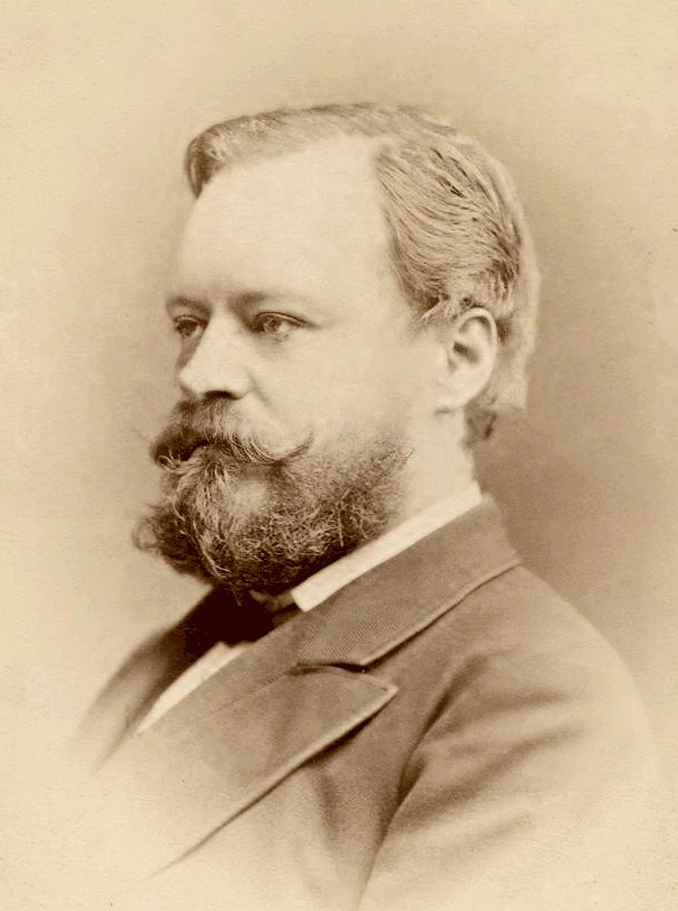
Harry Govier Seeley
Harry Govier Seeley was born on 18 February 1839 in London, the second son of Richard Hovill Seeley, a goldsmith, and Mary Govier. After his father's bankruptcy, he was sent to live with a family of piano makers and spent several years learning the trade before turning toward academic study. He attended lectures at the Royal School of Mines by figures such as Thomas Henry Huxley and Edward Forbes, which helped redirect his interests toward geology and palaeontology. In 1859 he entered Sidney Sussex College, Cambridge, where Adam Sedgwick hired him as an assistant in the Woodwardian Museum — a position that launched his formal scientific career. In 1872 he married Eleanora Jane Mitchell, with whom he had four daughters, one of whom, Maude, later married the palaeontologist Arthur Smith Woodward.
Seeley's early life of self-education shaped his working habits: he was industrious, self-reliant, and unusually broad in his intellectual interests. He supported himself by copying documents at the British Museum, where Samuel Pickworth Woodward encouraged him to study geology and comparative osteology. Seeley was not known for dramatic rivalries; instead, he built a career through steady museum work, teaching, and careful anatomical study. His professional path was unconventional — he turned down positions at both the British Museum and the Geological Survey to pursue independent research before later accepting professorships at King’s College London, Bedford College, and Dulwich College.
Seeley's most influential contribution was his 1888 demonstration that dinosaurs fall into two major groups — Saurischia and Ornithischia — based on pelvic anatomy, a classification that remains foundational in dinosaur systematics. He authored numerous papers on fossil reptiles, curated major museum collections, and was elected a Fellow of the Royal Society in 1879. His work helped professionalise British palaeontology during a period of rapid expansion in natural-history research. Seeley died on 8 January 1909 in Kensington, London, leaving behind a legacy defined by rigorous anatomical insight and one of the most enduring taxonomic frameworks in vertebrate palaeontology.
Seeley's early life of self-education shaped his working habits: he was industrious, self-reliant, and unusually broad in his intellectual interests. He supported himself by copying documents at the British Museum, where Samuel Pickworth Woodward encouraged him to study geology and comparative osteology. Seeley was not known for dramatic rivalries; instead, he built a career through steady museum work, teaching, and careful anatomical study. His professional path was unconventional — he turned down positions at both the British Museum and the Geological Survey to pursue independent research before later accepting professorships at King’s College London, Bedford College, and Dulwich College.
Seeley's most influential contribution was his 1888 demonstration that dinosaurs fall into two major groups — Saurischia and Ornithischia — based on pelvic anatomy, a classification that remains foundational in dinosaur systematics. He authored numerous papers on fossil reptiles, curated major museum collections, and was elected a Fellow of the Royal Society in 1879. His work helped professionalise British palaeontology during a period of rapid expansion in natural-history research. Seeley died on 8 January 1909 in Kensington, London, leaving behind a legacy defined by rigorous anatomical insight and one of the most enduring taxonomic frameworks in vertebrate palaeontology.
References
• Seeley HG (1888) "On the Classification of the Fossil Animals commonly named Dinosauria". Proceedings of the Royal Society of London, 43: 165-171.
• Linda Hall Library "Seeley's Dinosaur Dichotomy, 1888". Paper Dinosaurs, 1824-1969.
• Seeley HG (1869) "Index to the Fossil Remains of Aves, Ornithosauria and Reptilia, from the
Secondary System of Strata. Arranged in the Woodwardian Museum of the University of Cambridge". Cambridge: Deighton, Bell, and Co.
London: Bell and Daldy.
• Weishampel DB and White NM (2003) "The Dinosaur Papers: 1676-1906".
• Seeley HG (1901) "Dragons of the Air, an Account of Extinct Flying Reptiles".
• (1907) "Eminent Living Geologists: Professor H. G. Seeley". The Geological Magazine, 4(6): 241-252. DOI: 10.1017/S0016756800133473.
• Lydekker R (14 January 1909) "Obituary. Prof. H. G. Seeley, F.R.S." Nature, 79(2046): 314–315. DOI: 10.1038/079314b0.

Discoveries and descriptions ...


